
10.1 Weymouth is a seaside resort, the third largest settlement in Dorset and the largest town in the Dorset Unitary Council Area. Its economy is dominated by lower-paid employment and there is a significant amount of outward commuting to Dorchester and other areas for employment purposes. Unemployment and lower-paid work are a significant local issue.
10.2 The 2019 Index97 of Multiple Deprivation (IMD) shows that seven of the 31 LSOAs98 in Weymouth are amongst the 20% most deprived areas in the country and some of the most deprived in Dorset for employment as well as education and skills, health and disability, and barriers to housing and services; whilst other parts of Weymouth are more affluent and in the 20% least deprived category. This makes for a very varied Neighbourhood Plan area with significant contrasts. The average income for the area in 2019, for instance was £39,929, which was above the national average, yet the average lower quartile income for households with one income was £14,745, and for households with two incomes was £29,490. This situation is thought not to have changed greatly.
10.3 The Weymouth local economy is overly dependent on tourism, the harbour and local visitor attractions. There are also a significant number of residents working in Defence and Aerospace, mostly employed at the Granby Industrial Estate, just outside Weymouth, but also on Portland, as well as at Winfrith and Yeovil. Additionally, there are many people working in the building and housing industry, many of whom commute out of Weymouth to work.
10.4 The 2021 Census tells us that 52.7% of the resident population who are over 16 were economically active. 2.7% were unemployed in 2021. 65% of the working population worked full-time. 57% of people went to work by car. 23% worked from home (it was during Covid). Only 3% travelled to work by cycle and 12% walked (25% in Melcombe Regis ward). Most of these percentages are regarded as ‘worse than’ the Dorset county averages.
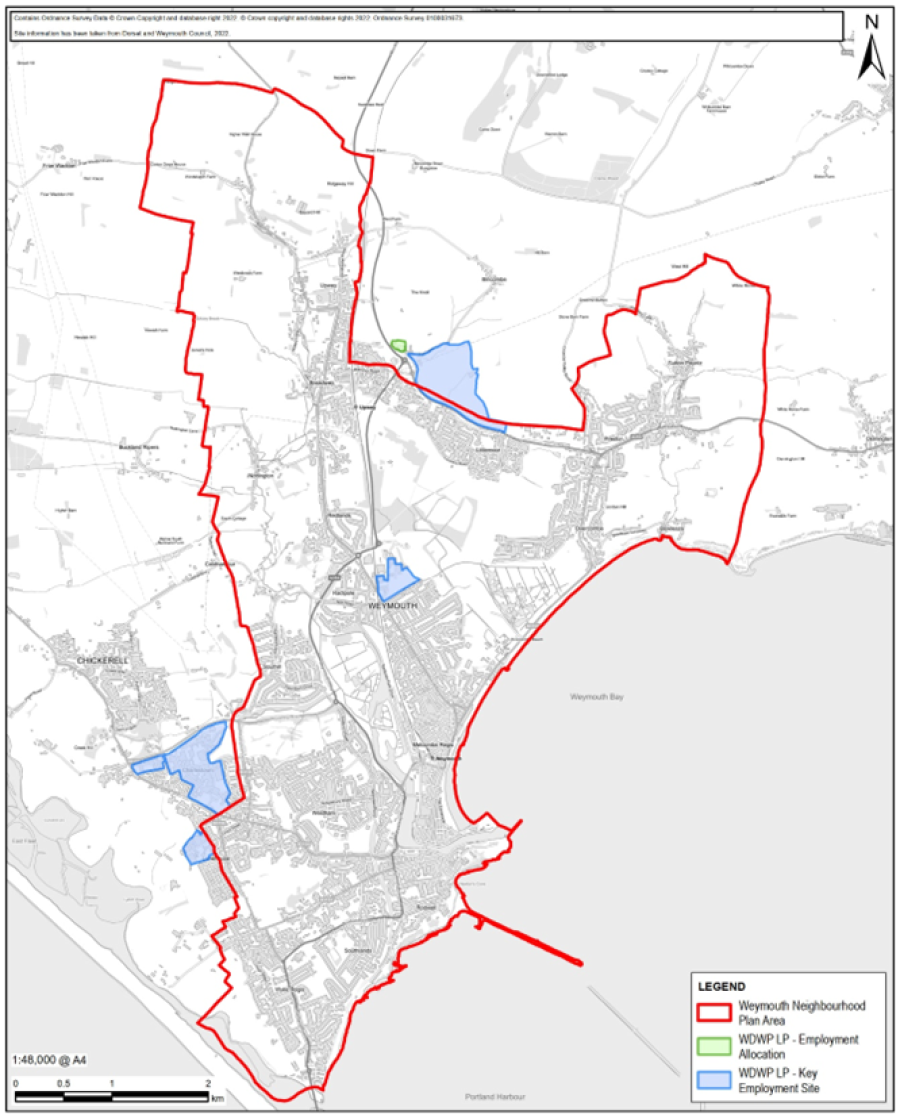
10.5 The 2015 Local Plan identified several Key Employment Sites in and near to Weymouth. The Mount Pleasant Business Park is the primary site: but most of the development on this site has been given retail permission contrary to the planning policy. The draft Dorset Council Plan identifies the Littlemoor Urban extension as a Key Employment Site, see Map 27. The Dorset & BCP Employment Land Study March 2024 estimated that the Mount Pleasant Business Park only had 0.7ha available and that the Littlemoor Urban Expansion has 8ha and that availability across the extant industrial estates was low99.
10.6 ‘Employment and Skills’ was identified in community consultations as the most important single issue for Weymouth. The lack of good quality jobs and training opportunities was identified by 57% of responders as critical for Weymouth’s future. Many aspects of the job market were criticised. The limited range and lack of year-round jobs, poor wages and lack of skilled jobs were repeatedly cited. The lack of training and career opportunities for young people was a particular concern. Weymouth College and nearby Kingston Maurward College are further education colleges providing graduate limited higher education facilities courses (HND, HNC and Foundation Degrees) are provided at Weymouth College linked to Plymouth University and Bournemouth University respectively. Bournemouth and Exeter Universities are the nearest universities.
10.7 The policy supports the development of facilities that will enable the provision of a broader range of study in terms of course scope and academic depth that will avoid the need for students to travel outside of the geographical area.
10.8 In 2021, almost half of the resident population (45%) aged over 16 had a level 1-3 qualification. 17% had no qualification and 27% had a level 4 qualification or higher. 28% of the workforce were in managerial or professional occupations. 13% worked in caring and leisure services. 8% worked in sales and customer services.
10.9 Weymouth Town Centre has a large area of protected primary shopping and secondary frontages. In these areas, shops are encouraged as well as other commercial uses such as offices at first floor. The retail sector however has declined significantly over the past few years in common with many other Town Centres nationwide. The Town Centre retains a strong leisure service provision including cafés, restaurants, bars/nightclubs, public houses, takeaways, and a cinema. There are also leisure uses that reflect its role and function as a coastal resort, which make a marked contribution to its overall character and vitality; such as amusement arcades, a theatre, and the Sea Life Centre.
10.10 There is a consensus locally that the Town Centre has an important role to play in the future life and wellbeing of the town but needs a significant revitalisation to do so. The Weymouth Town Centre Masterplan 2015 made a start. It identified a range of regeneration proposals that would deliver many new jobs and homes and revive the fortunes of the Town Centre. However, much of the potential identified by the masterplan remains unrealised. The Masterplan needs refreshing to take account of the very discernible changes in culture, fashions and habits that have been taking place post-Covid.
10.11 The policies that follow are very much pro-business and more importantly pro-jobs. But not just any jobs, for too long the Weymouth job offer has been inadequate in so many ways. The Neighbourhood Plan’s approach is consistent with the NPPF para. 85 in wanting to “help create the conditions in which businesses can invest, expand and adapt … taking into account both local business needs and wider opportunities for development” and thereby achieving the economic objective of the NPPF – to help build a strong, responsive, and competitive economy, by ensuring that sufficient land of the right types is available in the right places and at the right time to support growth, innovation, and improved productivity”.
10.12 The policies in this section of the Neighbourhood Plan are intended to promote and facilitate development in the growth sectors and industries, with an emphasis on green technologies and green jobs as well as those that will benefit from being located in a coastal and marine environment. This does not negate further tourism development, which Weymouth needs, but it does mean prioritising the kind of tourism development that the Weymouth of the future wants.
10.13 In this way we hope local people will benefit from the local availability of good jobs, higher wages, and better prospects.
Our Neighbourhood Plan Policies and their Explanation/Justification
Policy W35: Loss of Business Premises
1. Outside key employment sites, development proposals for change of use of employment land and premises to non-employment uses will be resisted unless it can be demonstrated that the existing use is no longer economically viable, and all reasonable steps, including appropriate and sustained marketing, have been taken to let or sell the site or building for employment purposes for a period of at least 12 months or other period agreed with the local planning authority.
2. The redevelopment of employment land and premises for non-employment uses will be permitted where it will not prejudice the efficient and effective use of the remainder of the employment area and;
10.14 There is evidence that Weymouth has been experiencing a loss of employment land because of the pressures on employment land, particularly to residential use, or because premises and sites are no longer fit for purpose or alternative business use.
10.15 The Local Plan acknowledges the importance of sustainable economic growth to Weymouth and includes policies to protect existing employment sites including those it identifies as being ‘key employment sites’. These are the larger employment sites that “contribute significantly to the employment land supply for B class uses” and serve a wider than local jobs market. Mount Pleasant (with 5ha of employment land approved) is identified in the Local Plan as the location of a ‘key employment site’ (see Map 27) as are those adjacent to the neighbourhood area in Littlemoor Urban Extension (with 8ha of employment land approved) and Chickerell, at Granby Industrial Estate, Lynch Lane Industrial Estate, and Link Park. They are all subject to Policy ECON2, “Protection of Key Employment Sites”, in the Local Plan.
10.16 Policy W35 makes it clear that we shall continue to support existing businesses in the interests of economic growth and prosperity, if it is appropriate and viable to do so in that location.
10.17 Policy W35 is intended to protect the business premises of the neighbourhood area unless it is clear they are redundant and no longer needed. When existing sites and premises become available for re-use, we expect every effort to be made by the owner to market the site in the hope of securing a viable alternative employment use that will contribute to economic growth and provide much needed local employment. Weymouth is in a period of transition and at least 12 months, and preferably 18 months, is necessary to allow maximum retention of local employment sites. After that period, any redevelopment or change of use proposal should comply with the appropriate development plan policies.
10.18 In support of the town’s economic fortune, policy W35 is supportive of development that ensures existing employment sites and premises remain suitable to meet modern demands and practices. The policy includes safeguards to ensure that the development is appropriate to its location and does not result in any unacceptable impact on neighbours, infrastructure, or the environment.
Policy W36: New Business Development
1. Development proposals that provide additional employment opportunities through new business start-ups, the expansion of existing businesses, and the creation of workshop units and business hubs for starter businesses and micro enterprises, on brownfield sites or through the sympathetic conversion of redundant buildings, within the DDB will be supported subject to such development:
2. Proposals that involve the creation of new employment opportunities on greenfield land or outside the DDB will be supported so long as they are:
3. Proposals in residential areas to provide live/work units or facilitate home working in association with existing dwellings, where planning permission is required, will be supported where:
4. Where required any application should be accompanied by appropriate site specific assessments, which might include a Flood Risk Assessment, Noise Assessment or Archaeological Assessment to demonstrate that the development is acceptable or to provide appropriate mitigation measures.
10.19 The NPPF (para. 85) says we “should help create the conditions in which businesses can invest, expand, and adapt. The approach taken should allow each area to build on its strengths, counter any weaknesses and address the challenges of the future”.
10.20 We are mandated by the community to broaden the business base and appreciate that the policy approach espoused by the NPPF requires policies to be flexible enough to accommodate a variety of needs and changing business practices.
10.21 Policy W36 supports new business development that can increase the range of local job opportunities.
10.22 The Site Options Assessment Report 2022 identified several redevelopment opportunities in the vicinity of the Town Centre on sites that are obsolete or under-used that could provide new employment opportunities in locations that are generally suitable for employment uses. Policy W36 supports such redevelopment proposals subject to them being appropriate for their location, satisfying the policy requirements of the Neighbourhood Plan and the development achieving high standards of clean energy efficiency.
10.23 Support for a particular development proposal should be conditional on the community and economic benefits to be derived from the development significantly outweighing any harmful impact on neighbours, infrastructure, or the environment that cannot be satisfactorily mitigated. New retail uses will be resisted on sites where it would result in an over-provision of similar businesses in the location.
10.24 The preference and priority are for employment-related development proposals that will:
10.25 There are buildings and locations in the neighbourhood area that could serve well as workshops, business centres and hubs of enterprise and innovation, and offer a range of work units, central shared services and even support on site. Policy W36 is supportive of such initiatives as they arise, subject to the businesses individually or collectively not resulting in an unacceptable impact. Where an appropriate building falls outside of a Defined Development Boundary, Local Plan Policy SUS3 would have primacy in determination of any application to protect the character of the countryside.
10.26 Post-Covid there is a discernible and growing interest in homeworking, which has been made easier and more appealing by the increasing availability of a superfast and efficient communication network. Policy W36 is generally supportive of the extension of a dwelling or small-scale development within its curtilage, for appropriate business purposes by the dwelling’s occupants, if it will not result in any unacceptable impact on neighbours or the environment.
10.27 An important strand of our approach, to economic growth and prosperity, is creating jobs in the newer, more knowledgeable-focussed industries to offset losses in more traditional industries. This means nurturing new businesses and supporting innovation. It also means, as the NPPF (para. 87) says, planning “positively for the location, promotion and expansion of clusters or networks of knowledge driven, creative or high technology industries”.
10.28 The policy will align with the relevant environmental targets and objectives as shown in the table below.
| Policy W36: Relevant Environmental Targets | |
|---|---|
| Objective 1: |
Carbon Neutrality Targets 1-8 inclusive |
| Objective 2: |
Resource Efficiency Targets 9-21 inclusive |
| Objective 3: |
Biodiversity Net Gain Targets 22-25 inclusive |
| Objective 4: |
Climate Change Management Targets 26-31 inclusive |
Policy W37: Mixed-Use Employment Schemes
Outside of the Key Employment Sites identified in the Local Plan, development proposals for the appropriate conversion or redevelopment of buildings and sites for mixed use development (including residential) within the Defined Development Boundary, will be supported providing;
10.29 Taking advantage of opportunities to expand the economic base of the area and increase local job opportunities is a key aim. If this can be achieved on major redevelopment sites in the town whilst also adding valuable dwelling units, especially if they extend the range of local housing choices, it represents a win-win for Weymouth.
10.30 The Dorset Strategic Economic Strategy recognises the major employment opportunities that could be derived from mixed-use redevelopment of locations adjacent to the Town Centre. This is reflected in the Local Plan with policies for the key areas of:
All are proposed for extensive mixed-use redevelopment, which includes commercial and tourism-related uses as well as some residential space. All are relatively close and convenient to existing residential areas.
10.31 Several further substantial and significant sites were identified as having potential for mixed use redevelopment by the Site Options Assessment 2022101, which was carried out on behalf of the Town Council. Many of the most noticeable of redundant buildings and sites are in or adjacent to the Town Centre. Many have site constraints and issues that need to be acknowledged and addressed in any development proposal. Many will involve extensive and costly redevelopment. Several are in the ownership of Dorset Council.
10.32 Landowners are encouraged to realise the potential of these ‘assets’; to maximise the benefit of these sites for the local economy; and help increase ways to meet local housing needs. A return of 30% of the previous number of jobs on the site is considered to be a reasonable target for employment and 50% affordable homes for residential development was set as a target by the Jobs Theme Group.
10.33 Several potential redevelopment sites and their associated issues and opportunities were raised by the public during the various community consultations. During the plan-making process, the Jobs Theme Group, supporting the Steering Group, considered the following at length:
Consideration of the redevelopment of these sites should be an integral aspect of any review and refreshing of the Town Centre Strategy. Any development proposals should be in accordance with policy W39.
10.34 Amongst other redevelopment opportunities in the vicinity of Weymouth Town Centre the Theme Group made detailed recommendations regarding the future of Jubilee Sidings (which has resulted in policy W24) and expressed a considered opinion about the long-term future of other Town Centre car parks (which has resulted in policy W32).
10.35 Whilst such projects, by nature of the circumstance of the site or situation may not be able to comply with all the policies in the Neighbourhood Plan, they will be expected to demonstrate high sustainability credentials.
10.36 The policy will align with the relevant environmental targets and objectives as shown in the table below.
| Policy W37: Relevant Environmental Targets | |
|---|---|
| Objective 1: | Carbon Neutrality Targets 1-8 inclusive |
| Objective 2: | Resource Efficiency Targets 9-21 inclusive |
| Objective 3: | Biodiversity Net Gain Targets 22-25 inclusive |
| Objective 4: | Climate Change Management Targets 26-31 inclusive |
Policy W38: Higher & Further Education & Skills Provision
Development proposals for higher and further education including university-level provision and for skills training, especially associated with technical and green skills, shall be supported provided the development;
10.37 Community consultation in 2020-21 identified a discernible dissatisfaction with the local provision of higher education and training opportunities. There is a lack of opportunity to undertake University Degree Courses whilst being resident in Weymouth. Additionally, there is a national shortage of qualified persons to undertake solar panel and heat pump installation and commissioning. Our approach, to economic growth and prosperity, seeks to increase local provision, in the interests of diversifying education, training, and skills in synergy with business growth; improving prospects for the young and under-qualified; retaining our young talent; and reducing commuting. We are keen to encourage creativity, technology, innovation, and green jobs102, as well as jobs that build on farming, food production, the coastal and maritime location.
10.38 Policy W38 provides support for sustainable development proposals that extend local provision and serve to encourage local demand for education and skills training amongst the adult population. Development proposals should set a high standard of innovation and sustainability commensurate with the status of the facility within the neighbourhood area.
10.39 The policy will align with the relevant environmental targets and objectives as shown in the table below.
| Policy W38: Relevant Environmental Targets | |
|---|---|
| Objective 1: | Carbon Neutrality Targets 1-8 inclusive |
| Objective 2: | Resource Efficiency Targets 9-16 inclusive |
| Objective 3: | Biodiversity Net Gain Targets 22-25 inclusive |
| Objective 4: | Climate Change Management Targets 27-31 inclusive |
Policy W39: Weymouth Town Centre
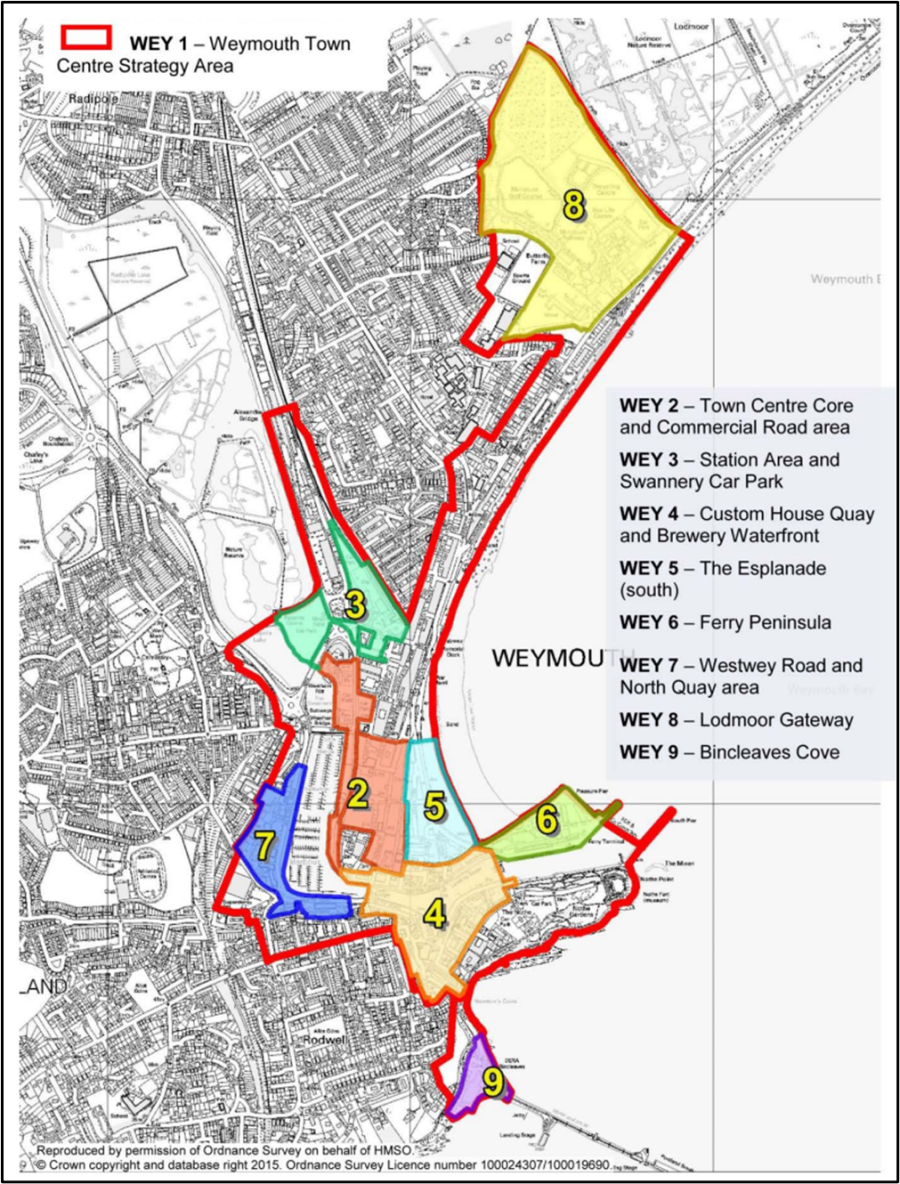
1. Development proposals within the area defined as Weymouth Town Centre on Map 28 should generally conform with the Local Plan policy ‘Weymouth Town Centre Strategy’ and the latest Town Centre masterplan.
2. Development and change of use that contributes to a diverse range of uses in the Town Centre including new office, leisure, community, hotel, retail, and residential use, will be supported if they:
3. Proposals which seek to stimulate an appropriate evening economy in the Town Centre are strongly encouraged.
4. Proposals which make more intensive use of upper floors and underused floorspace in the Town Centre will be supported.
5. Public realm improvement proposals, which will enhance the appeal of, and use of, the Town Centre by pedestrians, are strongly supported.
6. To protect the historic environment, proposals must ensure that any impact upon designated or non-designated heritage assets (including assets of archaeological importance) and their settings have been assessed in accordance with national policy and guidance and will only be supported where they meet the relevant requirements of the NPPF and Development Plan.
10.40 Despite an obvious decline in its retail role and overall vitality, Weymouth Town Centre is still highly regarded and considered by the community as an important focal point for so many of the facilities, activities, and services it requires. This is evident from the several community consultations that have been carried out between 2021 and 2023.
10.41 The NPPF (para.90) recognises the on-going significance of Town Centres to towns such as Weymouth and urges us to take a positive approach to the growth, management, and adaptation of Town Centres to ensure they remain relevant and the heart of the community and the area.
10.42 Local Plan Policy WEY1 seeks to protect the Town Centre’s character, improve the public realm, encourage national and independent traders, encourage evening activity, by introducing more family friendly activities in appropriate locations, manage residual flood risk, citing the masterplan prepared for Weymouth & Portland Borough Council, which was adopted in 2015 as a Supplementary Planning Document (SPD).
10.43 The Weymouth Town Centre Masterplan103 was a response to community concerns expressed at the time about the wellbeing of Town Centre. Its vision was drawn from extensive consultation on the future of the Town Centre with key stakeholders, residents, businesses, and visitors to the area. The masterplan was heralded in 2015 as “the start of exciting changes aimed at ensuring that Weymouth can live up to local aspirations as an exciting, vibrant 21st century coastal town”.
10.44 The Weymouth Town Centre masterplan is a ten-year plan. It has served a useful purpose as a framework for change and improvement in a difficult economic climate, but it needs refreshing and updating. Circumstances have changed. The 2021 consultation on the new draft Dorset Local Plan acknowledged that “due to recent changes in shopping habits and the presence of various vacant sites around the Town Centre it is recognised that there is a need to regenerate parts of the Town Centre. It is anticipated that this regeneration could deliver at least 400 new homes along with the retail and business needs of the area”. It further acknowledges that there are many challenges to be faced if Weymouth Town Centre is to fulfil a vital and sustainable role in the life of the town, the people of the area and its many visitors.
10.45 The Town Centre Masterplan is in need of review. Much of the community feedback from the neighbourhood planning consultations provides valuable guidance as to how local people would like their Town Centre to be transformed to play a vital role in the life of the town and its inhabitants in the first part of the 21st century. Much of the recent focus has been on the seafront, which is regarded as part of the Town Centre. It will be important to integrate policy proposals for the revitalisation of the seafront with a refreshed Town Centre Masterplan. Much of the feedback from community consultation highlighted the benefit of independent retailers bringing distinct character and shopping experiences to the Town Centre.
10.46 Policy W39 recognises the value of a masterplan for the Town Centre that promotes and stimulate a diverse range of relevant uses whilst safeguarding and enhancing the core retail offer. The charm, character, and overall sense of pleasure and safety experienced by most Town Centre users is of particular importance. All development should contribute positively to furthering the positive experience that a visit to Weymouth Town Centre should engender. In response to community consultations, the Neighbourhood Plan supported the development of family friendly activities (e.g. cinemas and restaurants) to broaden the demographic appeal of the Town Centre later into the evening and strengthen the economic benefit links between daytime and night-time economies.
10.47 The Town Centre Masterplan identifies key development sites in the Town Centre supported by Strategic Policies addressing these. £23M Levelling Up Funding has been obtained to conduct infrastructure work on key sites on the Weymouth Harbourside. This will enable the essential harbour walls repair to be completed and enable some site infrastructure to be put in place. The Weymouth Neighbourhood Plan process has identified that the 2015 LP and the 2021 Draft Local Plan, as drafted, will not deliver sufficient affordable housing for rent to meet the significant need in Weymouth over the plan period. For these reasons clause iv has been inserted into condition 2 of this policy.
10.48 The WNP would have liked to have allocated the St Nicholas Street site for high density residential development with high levels of affordable homes but were unable to carry out the required Sequential and Exception Tests required by Dorset Council to support this. The Viability Testing demonstrated that a market-led development on this brownfield site in the flood zone 3 would struggle to deliver even a small proportion of affordable homes without significant external funding. It is therefore recommended that Dorset Council seeks Homes England funding either directly or through developer to ensure this site delivers at least 35% Affordable Homes.
10.49 Good quality, sensitive design should be a key factor. Development proposals should include a design statement to show how they have responded to local design guidance and how the development will make a positive contribution to achieving the objectives of the Masterplan through design.
10.50 The policy will align with the relevant environmental targets and objectives as shown in the table below.
| Policy W39: Relevant Environmental Targets | |
|---|---|
| Objective 1: | Carbon Neutrality Targets 1-8 inclusive |
| Objective 2: | Resource Efficiency Targets 9-21 inclusive |
| Objective 3: | Biodiversity Net Gain Targets 22-25 inclusive |
| Objective 4: | Climate Change Management Targets 26-31 inclusive |
Policy W40: Transitory Activities and Uses
The transitory use of buildings and open spaces for organised events and activities, which require planning permission, will be supported provided that the proposed transitory use:
10.51 Consultation in association with a seafront study in 2022 identified a strong support for the increased provision of spaces to stage public events and festivities, amongst persons of all ages within the resident population. The seafront study recognises that there is considerable scope to make good and better use of several of the open spaces and the Esplanade itself.
10.52 The continued development of a relevant and contemporary annual events and festivals programme is supported. Weymouth Town Council has an approved Events Vision “that by 2025 Weymouth has developed a comprehensive programme of high-quality sustainable community inspired and tourism-based events and festivals that cultivates community creativity for maximum economic and environmental benefit and social enjoyment throughout the town council area”.
10.53 Policy W40 supports the transitory use of existing spaces, especially, but not exclusively, within the Town Centre area for organised events that will attract visitors as well as local people as spectators and/or participants.
10.54 It also recognises that there could be significant economic value in taking advantage of, or extending, the ‘tourist season’. Making best use of what we have, but on a transitory basis, of no more than six months, which would cause little in the way of long-term harm to the environment or nuisance to nearby uses, is consistent with a sustainable approach to tourism.
10.55 Such transitory uses that attract large numbers of attendees, have the potential to cause nuisance and disturbance to neighbours and neighbouring uses. Those applying for the extended temporary use of buildings and open spaces for organised events and activities should provide evidence, at the time of application, of meaningful consultation with the host community; and the development proposal should include measures to mitigate satisfactorily any concerns the community may have.
10.56 The policy will align with the relevant environmental targets and objectives as shown in the table below.
| Policy W40: Relevant Environmental Targets | |
|---|---|
| Objective 1: | Carbon Neutrality Targets 2, 3 |
| Objective 2: | Resource Efficiency Targets 9, 10, 14, 16 |
| Objective 3: | Biodiversity Net Gain Targets 25 |
| Objective 4: | Climate Change Management Targets 27-31 inclusive |
Policy W41: Sustainable Tourism Development
1. Sustainable tourism development proposals and/or extensions to or expansion of existing tourism uses that extend the tourism season, enhance the visitor economy and increase the quality and diversity of the tourism offer are supported in principle throughout the neighbourhood area.
2. All proposals must be of a scale, type, and appearance appropriate to the character of the location and ensure that any impact upon designated or non-designated heritage assets (including assets of archaeological importance) and their settings have been assessed in accordance with national policy and guidance.
3. Development needs to be sympathetic to the wider environment and must not result in an adverse impact, individually or cumulatively, upon designated landscapes and sites of biodiversity importance.
4. Development that results in harmful impacts on local services, roads and other infrastructure will not be supported.
5. Development that delivers a wider environmental or community benefits will be encouraged.
10.57 Weymouth is Dorset’s premier tourist destination and long may it be so. Furthering the beneficial impact of tourism is an essential part of our approach to economic growth and prosperity.
10.58 It is recognised that tourism has not always been in the best interests of the area, its environment, and its inhabitants. The ‘cheap and cheerful’ image that has evolved for many of the UK’s seaside resorts has proven not to stimulate major investment. Seasonality, low wages, traffic congestion, various forms of pollution, crime and safety issues have all repressed economic growth.
10.59 Policy W41 endeavours to help establish the nature of the tourism development that would be most beneficial to the area, whilst building on a discernible trend in revitalisation that has occurred to many seaside resorts occurred post-Covid. Weymouth is determined to capitalise on this trend and do so by promoting sustainable tourism development, with high quality accommodation, facilities, and activities, to give the town an overall cultural uplift.
10.60 Policy W41 reflects a desire to promote and support eco-tourism; activity and health-related tourism, all-year round tourism; and extolling the virtues of the area’s natural environment, heritage locations and high-quality facilities.
10.61 The loss of visitor attractions impacts on the local community as much as it affects the visitor-offer. Proposals for new indoor leisure facilities on suitable sites in the Town Centre and along the Sea Front, which are in line with policies on sustainable tourism, are likely to enhance residents’ leisure access for the benefit of the Weymouth economy, and are encouraged subject to satisfactory conditions being imposed to control operating arrangements and/or opening hours to mitigate the environmental impacts of the development.
10.62 Sustainable tourism is committed to generating a low impact on the surrounding environment and community by acting responsibly while generating income and employment for the local economy and aiding social cohesion. Rather than a type of product, sustainable tourism is an ethos that should underpin all tourism activities and is integral to all aspects of tourism development and management and not just an add-on. We expect any such proposal to demonstrate its sustainability credentials and be accompanied by an environmental impact assessment.
10.63 The policy will align with the relevant environmental targets and objectives as shown in the table below.
| Policy W41: Relevant Environmental Targets | |
|---|---|
| Objective 1: | Carbon Neutrality Targets 2, 3 |
| Objective 2: | Resource Efficiency Targets 9, 10, 14, 16 |
| Objective 3: | Biodiversity Net Gain Targets 25 |
| Objective 4: | Climate Change Management Targets 27-31 inclusive |
Policy W42: Facilitating Offshore Renewable Energy Projects
Development proposals to facilitate low and zero carbon offshore renewable energy projects will be supported if:
10.64 The biggest opportunity for renewable energy generation in the vicinity of the neighbourhood area lies offshore. To date there has been resistance to such development off the coast of Dorset and the feasibility of an offshore renewable energy project must be carefully assessed, considering factors such as technological advancements, landscape and seascape impact implications for biodiversity and would require extensive community engagement.
10.65 The importance of locally generated renewable energy has increased multiple times over the past few years. Dorset CEE has estimated that “without deploying offshore wind or reducing energy beyond current projections we would need to find space for 2,000 more onshore turbines or use 28% of available land for additional solar panels. This reduces dramatically if we can reduce demand by 60% and is well within the potential limits if we develop an offshore wind farm”104.
10.66 The only offshore site in the south of England at present is the Rampion windfarm off Brighton. Most of the country’s offshore windfarms are installed along the eastern coast of the UK, in the North Sea. Yet, the Dorset coast is one of the best and windiest locations for offshore wind in England. The Regen Report on Low Carbon Investment Opportunities in Dorset105 produced for the LEP106, estimates that a 1GW offshore site would be able to generate about 30% of total 2018 energy use. “The network infrastructure from an offshore project could also unlock other net zero opportunities in the area, and investment could be expanded to relieve some of the electricity constraints facing Dorset. The network investment could also unlock other generation opportunities such as tidal stream electricity generation and support hydrogen production through electrolysis”.
10.67 The earliest an offshore wind site could be operational would be in the early to mid-2030s. The Regen report estimated the costs and benefits. An offshore wind farm of 1GW capacity would be over £1.5 billion, based on current project costs. The associated jobs would amount to approximately 2,300 FTEs. This estimate includes installation, manufacturing, operation, and maintenance, all of which could be localised in Dorset or neighbouring areas.
10.68 Policy W42 provides support in principle to facilitating development of the land based infrastructure within the neighbourhood area to support low and zero carbon offshore energy projects, including wind, tidal and wave as well as the downstream infrastructure needed for options such as green hydrogen production. It is of course acknowledged that any proposal for a large-scale offshore wind project would be a planning matter decided by the Secretary of State due to its national significance and Dorset Council and Weymouth Town Council would only be one of many statutory consultees to the planning application. However, proposals for a viability assessment in relation to the development of an offshore wind farm or other offshore renewable energy production capability would be supported in principle.
Policy W43: Community Energy Schemes
Community energy initiatives which contribute to the promotion, development, and delivery of sustainable energy sources for the neighbourhood area will be supported, provided:
10.69 The NPPF (para 161) encourages support for community-led initiatives for renewable and low carbon energy, “including developments outside areas identified in local plans or other strategic policies that are being taken forward through neighbourhood planning”.
10.70 The Community Consultation 2022 highlighted a widespread concern about the cost of energy and considerable interest in cleaner and cheaper energy sources. 66% of respondents cited installation costs as the greatest barrier to them accessing cleaner and cheaper energy sources with approximately half of people limited by knowledge of where to start and/or consistent information.
10.71 Community energy schemes encompass a wide range of projects initiated and managed by communities to generate, manage, and utilize energy resources collectively and often distributed via a ‘district heating network’ serving specific areas and neighbourhoods. The following examples demonstrate the diversity of potentially valuable community energy schemes, which can vary in scale, technology, and organisational structure, based on the specific needs, preferences and resources of each community. They include:
Solar Co-operatives: communities come together to install solar panels on rooftops or open land, often through a cooperative model where individuals or businesses invest collectively.
Wind Farms: communities invest in and operate wind turbines, either onshore or offshore, to generate electricity.
Hydroelectric Projects: community-owned hydroelectric facilities to utilize the power of flowing water to generate electricity.
Biomass Heating Systems: community-owned biomass boilers or district heating systems fuelled by locally sourced biomass, such as wood chips or agricultural waste, to provide heat for homes, businesses, or community buildings.
Biogas Plants: community-owned biogas facilities process organic waste to produce biogas, which can be used for heating, electricity generation.
Community-Owned Energy Storage: communities invest in energy storage systems such as batteries or pumped hydro storage, which can store excess energy generated during periods of low demand for use when demand is high or renewable generation is low.
Community Solar Gardens: these projects allow individuals or businesses who cannot install solar panels on their own property to purchase or lease a share of a larger solar array located elsewhere in the community, receiving credits or discounts on their electricity bills for the energy produced.
10.72 Opportunities are there to be taken on top of existing buildings, in association with new developments, and on marginal land outside the development area. The community is open to various forms of renewable energy generation and installation, of an appropriate scale with suitable safeguards. There is some local interest in establishing low-cost community energy projects and W43 supports such initiatives.
10.73 There is no doubt that renewable energy technologies will change over the plan-period. It should lead to smaller, less intrusive, as well as more efficient installations. Policy W43 aims to encourage and support community action and enterprise to harness local energy in the best interests of the community.
10.74 Policy W43 reflects a pro-active position and confirms support in principle to local energy initiatives of a high quality and standard107, and a willingness to give weight to the potential community benefits in considering the merits of a development proposal that is genuinely community owned for example the developers should be a registered co-operative or Community Benefit Society. In this regard, community investment opportunities should be offered first to those residing within the area, and at least 33% of the project should be owned by residents of the Plan area to ensure benefits are derived by the local community.
97 https://www.gov.uk/government/statistics/english-indices-of-deprivation-2019
98 Footnote: LSOA = Lower-layer Super Output Areas are small areas designed to be of a similar population size, with an average of approximately 1,500 residents or 650 household, on which statistics are derived.
99 Dorset & BCP Employment Land Study - March 2024
100 Footnote: Industries producing a product or service that contributes directly to preserving and enhancing the quality of the environment and associated with green energy, energy efficiency and waste reduction.
101 AECOM - WNP Site Options & Assessment Report - January 2023
102 https://educationhub.blog.gov.uk/2022/11/07/what-is-a-green-job-everything-you-need-to-know/
103 Dorset Council Weymouth Town Centre Masterplan - Supplementary Planning Doc - Sept 2015
105 Regen - Dorset Low Carbon Investment Opportunitie
106 Regen - Dorset Low Carbon Investment Opportunities
107 MCS Quality Assurance Scheme
< Previous | ^ Top | Next >