
11.1 In preparing the Neighbourhood Plan it was considered important from the outset to recognise that the Weymouth area comprised of many settlement areas each with their own character. The Character Area Assessment of 2021108 grouped these settlements into five areas based on density, constraints, access to facilities, typologies, design styles and era built; but in doing so it recognised that these areas were comprised of several settlements or neighbourhoods many of them relating back to their historic origins:
11.2 A Communities Theme Group was established early in the neighbourhood planning process. The first aim to be agreed following the first neighbourhood planning consultation in Dec 2020/Jan 2021 was a statement of intent to “celebrate the unique character and culture of each local neighbourhood and respond to their needs to enable our policies to be applied in a sensitive way, relevant to the locality ensuring resilient sustainable communities for all ages”.
11.3 Community consultation has guided the preparation of policies for the Neighbourhood Plan. In 2021 the community indicated some dissatisfaction with many aspects of the living environment. Traffic can be a nuisance, neighbourhood shops are not meeting needs, streets and spaces are in poor condition, community facilities are lacking, and the fear of crime is increasing. The 2022 consultation response confirmed that the sense of community and neighbourhood were “important or unique” to many people, and suggested priorities for safeguarding i.e. green spaces, shops, post offices, community centres, recreation, pubs/cafes, and churches. Walkabouts involving local residents also took place in 2021 to get to the heart of the neighbourhoods and the heart of the matter109.
11.4 The policies that follow address what are discernibly important to local people. They supplement policies in the Local Plan to ensure Weymouth’s neighbourhoods retain a strong sense of identity, enable, and support healthy lifestyles, and are safe and accessible. This approach is consistent with the NPPF para. 96 which states “planning policies and decisions should aim to achieve healthy, inclusive and safe places”. The focus is on:
Our Neighbourhood Plan Policies and their Explanation / Justification
Policy W44: Design
11.5 “Good design is a key aspect of sustainable development, creates better places in which to live and work and helps make development acceptable to communities” (NPPF para. 131).
11.6 The Weymouth Character Area Assessment identified five separate character areas based on “density, constraints, access to facilities, typologies, design styles and era built”. Within each of these character areas are to be found distinct villages, estates, and settlements, the result of centuries of growth and development. In the Town Centre area for instance, a recent design-related study identified 10 physically distinct areas. This rich and diverse tapestry reflects Weymouth’s past, defines Weymouth today, and provides an overall purpose for neighbourhood planning. The Weymouth Neighbourhood Plan celebrates and safeguards the unique identities of our local neighbourhoods.
11.7 Policy W44 seeks to ensure that new development is of high quality and appropriate to its location. Major development proposals should be accompanied by a design statement to show not only good design principles but also the local situation has been taken into account. This should include the relationship between buildings and streets, squares, parks, waterways, and other spaces.
11.8 Recent studies and community consultations have helped identify the special qualities of each character area and improved our understanding of how this can be reflected in development. It has enabled design criteria to be included as part of the locationally-specific policies in the Neighbourhood Plan. The Sutton Poyntz Neighbourhood Plan recognises the value of taking nearby building style and materials into account and the recognition of local character areas (Appendix D, Annex A).
11.9 Further design guidance is included in approved management plans and masterplans, and available from the local planning authority, which is obliged by the NPPF (para. 134) to prepare design guides or codes consistent with the principles set out in the National Design Guide and National Model Design Code, which reflect local character and design preferences.
Policy W45: Heritage Assets
11.10 We are encouraged by the NPPF (para. 196) to support a positive strategy for the conservation, appreciation, and enjoyment of the historic environment, including heritage assets most at risk through neglect, decay, or other threats. This strategy must reflect the significance of the heritage asset and its potential contribution to the physical and social character and appearance of the area.
11.11 Local Policy ENV 4. Heritage Assets provides strict guidance on how development proposals affecting a heritage asset should be approached and prepared.
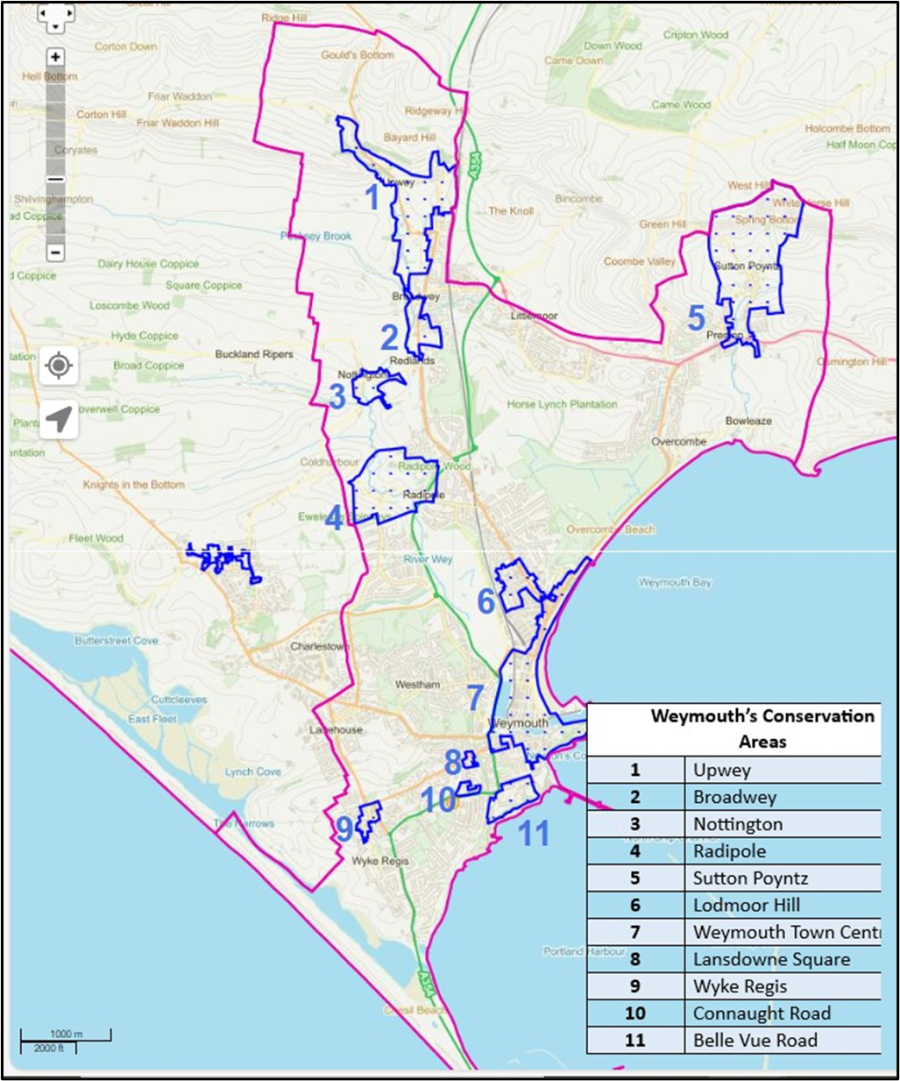
11.12 Weymouth’s heritage is rich and varied, much of it maritime and seaside related110, and many physical ‘assets’ remain in the several distinct settlements that make up the neighbourhood area. There are over 500 listed buildings and 11 conservation areas (see Map 29), and many more unlisted, but significant, heritage sites and buildings111.
11.13 The community has made clear in consultations that it expects the Neighbourhood Plan to appreciate the value of these assets and help ensure they are safeguarded for future generations and make a significant contribution to life in Weymouth going forward.
11.14 Policy W45 requires development proposals to recognise the significance that any identified heritage site or building may have to the nation and the local community and ensure that any development proposal avoids impact, resulting in harm and actively seeks to secure opportunities to enhance community appreciation of the asset.
11.15 Historic England112 and Dorset Council113 offer information and guidance on how listed buildings must be treated and what is and is not acceptable in conservation areas. More detailed guidance on individual locations is also available by way of a pre-application advice service offered by the local planning authority.
11.16 To broaden the impact of the development plan and aid developers, Dorset Council has committed to establishing a Local Heritage List to recognise those assets in the county that do not qualify for national listing status. The Local Heritage List is an ongoing project to create a record of other historic/heritage locations and features of local or regional significance, providing an opportunity for the community to nominate assets for inclusion on the list. The list “highlights assets that need consideration, celebration and protection within the planning system”114. Members of the public are encouraged to nominate what they consider to be suitable candidates for local heritage listing by way of a formal nomination assessment process.
Policy W46 Transport and Travel
11.17 There is little evidence that people are giving up the car. Car ownership has increased over the past 10 years and many commuters still go to work by car, although there has been an increase in home working since the Covid Pandemic of 2020/2021. There is evidence however that many people are unhappy about the impact of the motor vehicle. Traffic volume, speeds, congestion, and pollution are all mentioned frequently in consultation responses. The 2022 Community115 Consultation response showed 57% of respondents were concerned about vehicle traffic in the area they live causing a physical safety issue or air pollution risks.
11.18 The new Local Plan is likely to encourage the move away from car dependency towards healthy, lower carbon travel choices and lifestyles. The policy requires significant new developments to be located close enough to existing facilities or deliver viable new facilities to make walking and cycling a realistic choice. This approach has been taken into account by the housing policies of the Neighbourhood Plan.
11.19 As much as it would be good to reduce the use and impact of the motor vehicle considerably, policy W48 requires developers to be realistic in their assessment of the traffic implications of their development, based on current trends, and ensure that proposals include satisfactory access arrangements and highway improvements in accordance with the requirements of the Highways Authority; and include safe walking and cycling routes within the development, with suitable links to the wider transport network wherever possible. Adequate provision to ensure a local public transport service can serve the residents of major new residential developments should be an integral part of the design and layout of any scheme.
Policy W47: Public Transport
Development proposals that make public transport more accessible through improvements to the infrastructure and network such as interchange areas, travel linkages, bus stops / refuges and enhanced information provision and do not cause unacceptable harm to the surrounding area will be supported.
11.20 Within the neighbourhood area, we strongly support the more widespread and regular use of alternative transport modes to the private motor car. We are planning for an ageing and growing population. An effective and efficient public transport network and services are vital to the wellbeing of the community and the town.
11.21 The Town Centre, as you would expect, has ample facilities, and is generally well connected with the rest of the town. Redlands and Littlemoor are on major bus routes and Preston and Overcombe are also well served by a bus route, particularly in the summer season. Lodmoor and Radipole Spa also have a reasonable array of public transport facilities and access. Wey Valley has a strong linear form and access to facilities whilst Nottington and Radipole Village have no bus provision and Southill have recently had a limited service restored. Public transport access in Westham, Wyke Regis and beyond is more adequate with numerous bus stops on the main link road such as Portland Road but with poor service accessibility in the Lanehouse and Old Wyke areas. Despite this relatively comprehensive network, many people still regularly and steadfastly use a private motor vehicle for local trips. There is no doubt however that buses routes and bus frequencies are being reduced, making public transport less accessible to large numbers of our residents. Of particular concern, is the reduction in evening and weekend services, frequency and lack of provision for major events. Traffic congestion in the Town Centre has also impacted on the reliability of services. Ways need to be found to increase the appeal of public transport, to further encourage its use, and to encourage providers to respond positively to public demand.
11.22 Neighbourhood Plans are encouraged by the NPPF (para. 116) to promote public transport use. Policy W47 supports development that facilitates the greater appeal and/or ease of use of public transport, such as interchange areas, linkages, bus refuges and stops etc, as long as the impact of such development would not cause unacceptable harm to the surrounding area.
Policy W48: Off-Street Parking
11.23 The following quote from the 2022 Community Consultation seems to encapsulate local opinion: “too many cars park illegally because there are not enough allocated parking spaces. When new homes are built, they do not have enough spaces to meet the demand of growing families that grow up also have their own vehicles”.
11.24 Policy W48 is intended to ensure that development proposals for new housing and business sites include provision for sufficient vehicle parking and servicing spaces so as not to cause road safety concerns or congestion on the local highway network; and more than sufficient cycle parking and storage facilities. It is noted that Dorset Council Transport Planning intend to refresh the parking guidance and will seek to establish parking guidance for bicycles and mobility scooters116.
11.25 Development proposals should accord with Dorset Council’s published local parking guidance117 unless a different level of provision can be justified by local or site-specific circumstances. The design and layout of parking provision should seek to diminish the visual impact of parking provision on the street scene and minimise opportunities for illegal parking.
Policy W49: Vehicle Charging Facilities
The provision of public electric vehicle charging outlets in suitable locations will be supported.
11.26 The Government has decided to ban the sale of new diesel and petrol cars by 2035, as part of its efforts to tackle air pollution. The growth of electric vehicles will likely accelerate as technology allows them to travel greater distances on a full charge. We are expecting that more and more of Weymouth’s residents’ and visitors’ cars will be electric in the years ahead and will require more EV charging facilities in publicly accessible places.
11.27 The NPPF (para. 111) requires us to take account of the need to ensure an adequate provision of spaces for charging plug-in and other ultra-low emission vehicles. In addition to cars it is reasonable to expect that future demand will extend to EV charging provision for mobility scooters, electric bikes and scooters. The technology associated with such vehicles is still developing. It is difficult to predict the method and space requirements for keeping these vehicles charged and ready to travel in ten years’ time.
11.28 Provision of suitable electric charging points as an essential and integral part of all new developments is required under the Building Regulations. Policy W49 provides support in principle for adequate and appropriate charging facilities without causing nuisance to adjoining users and adding to any existing traffic/parking problem in the locality.
11.29 As Weymouth is at the end of a significant and lengthy tourist artery it seems logical and sensible to ensure that we provide adequate vehicle, e-bike mobility vehicles and scooters re-charging facilities alongside other tourist/visitor services. In accordance with the NPPF (para. 116), policy W49 supports the provision of electric vehicle charging outlets in suitable locations, that can be accessed by visitors and residents alike without causing nuisance to adjoining users and adding to any existing traffic/parking problem in the locality.
Policy W50: Cycle Routes
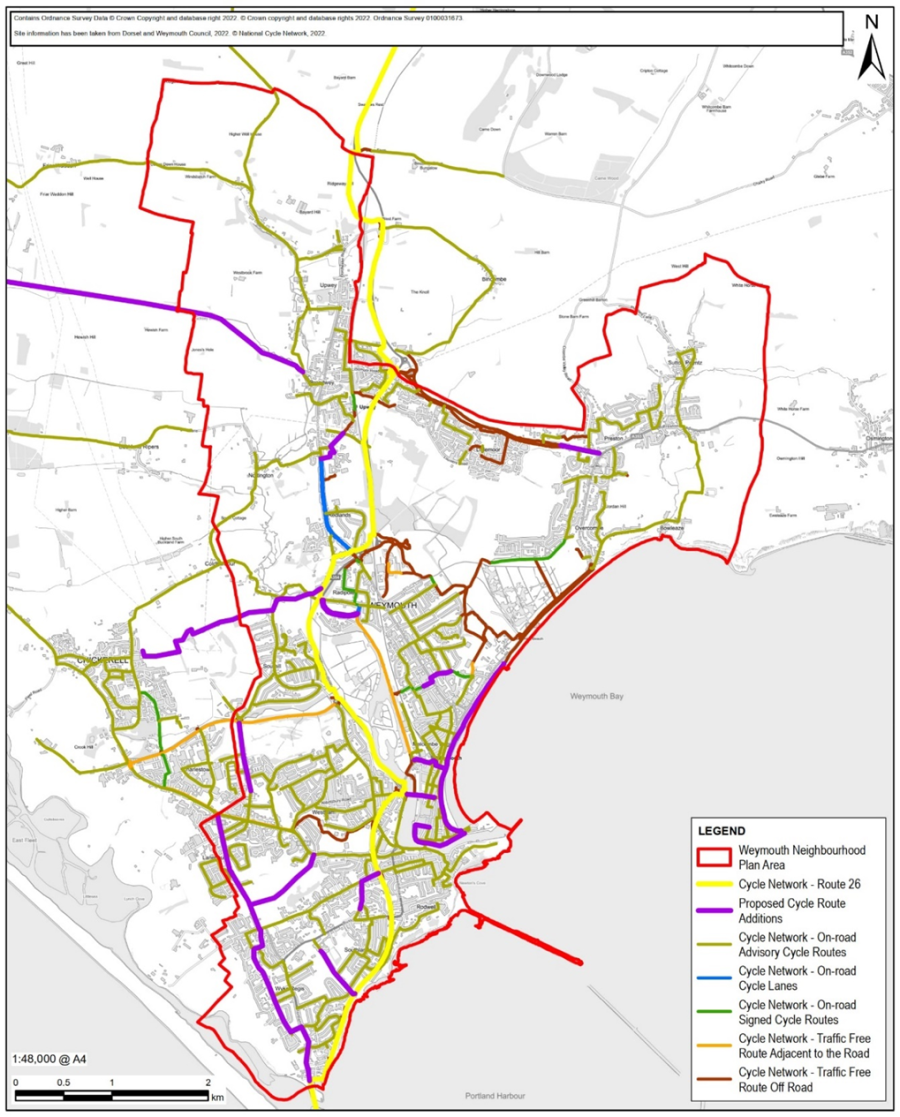
Development proposals to improve and extend existing cycle routes, to effect better segregation from vehicular traffic, and to link them to the wider network of walking and cycling routes (Map 30) will be supported.
11.30 The cycle network in the neighbourhood area (see Map 30) has been the focus of much study. Less than 10% of the local population appear to be regular cyclists. Only 4% of working adults cycle to work. The lack of a comprehensive cycle way network is undoubtedly a contributory factor as is the perception of safety risk. Map 30 shows there are several significant gaps in the network and limited lengths that are free from motor vehicles.
11.31 The Rodwell Trail is one of the area’s great leisure assets and shows how a good quality safe route can serve the community. The Rodwell Trail is a shared use walking and cycling path using a former railway line, which provides a pleasant, traffic free 3.5km walk or cycle ride from Westham Bridge in the heart of Weymouth's Town Centre to Ferry Bridge. It forms part of the National Cycle Network Route 26 (Portland to Portishead).
11.32 The 2023 Community Consultation exposed a variety of criticism and considerable dissatisfaction with other parts of the current cycleway network118. Many of the complaints are from frustrated other road users who share road space with cyclists. Two-thirds of respondents were happy to support improvements to current cycle routes by extending and connecting existing cycleways and linking them to the wider network. Map 30 shows proposed cycle route additions proposed by Dorset Council.
11.33 Many of the measures required to make cycling safer in the Weymouth area and more appealing to local people relate to education and understanding amongst the population, leading to a greater tolerance of and respect for all road users. More modal separation on the highways and footpaths would help and innovative solutions taking account of lessons learned from current measures should be utilised in future planning of cycle routes. There is no doubt however that a more joined up network of dedicated cycle routes is required, with cycle paths that provide links to services and facilities within residential areas and connect neighbourhoods together, and routes to employment areas and the Town Centre. The lack of a much-needed sea front/promenade route from Lodmoor to the Town Centre and Pavilion is often cited in community consultations.
11.34 The suggested improvements are based on analysis of the current network focussing on improving the safety for children cycling to schools and joining up the wider cycling network.
11.35 Policy W50 is supportive of improvements and extensions to the cycleway network, particularly to improve access to schools, public amenities, and other transport hubs. The aim must be to make cycling more appealing by improving safety and reducing risks and conflicts. It is hoped that such developments / improvements will lead to a shift in public opinion and a significant increase in regular cycle use.
11.36 Public feedback has identified a number of ‘gaps’ in the Weymouth cycling network for consideration under policy W50 as follows:
11.37 Policy W50 also recognises the need to connect with cycle routes into adjacent areas including an extension along the South Dorset Ridgeway west from the Weymouth-Dorchester trail as far as Hardy's Monument and further along the Rodwell Trail using the remainder of the disused Weymouth to Portland railway line to link to Easton on Portland. It is important that Dorset Council takes an integrated approach to planning new routes in order to create an effectively ‘connected’ network.
Policy W51: Traffic Impact
Development proposals to reduce the volume and impact of motor vehicles including:
11.38 Traffic and the several issues related to it are a major grumble amongst the residents and business of Weymouth. In 2021 it was the highest ‘dislike’ about the town, with concerns about road safety and air pollution dominating the consultation response. The 2022 consultation identified major concerns about the volume and speed of traffic as well as the congestion when speeds were restricted. 81% of respondents in 2022 agreed that we should “reduce car movements and encourage sustainable transport modes in local neighbourhoods”.
11.39 The NPPF para. 108 requires plans to ensure the “potential impacts of development on transport networks can be addressed… “opportunities to promote walking, cycling and public transport use are identified and pursued” and the patterns of movement, streets, parking, and other transport considerations are considered to be an integral part of design and development.
11.40 Policy W51 supports development measures intended to reduce the impact of traffic on the daily lives of people in the neighbourhood area, such as those to facilitate traffic calming or defining pedestrian priority areas. The need for traffic calming was a consistent issue raised during the neighbourhood walkabouts. It is important that such schemes are not imposed on a local community without proper consultation. Those who live and work in the local area, who have understanding of how the road network functions, will have a good idea of what will work and will not.
11.41 Attractive and adequate Park and Ride provision is essential if Weymouth is to permanently reduce the impact of the motor car on everyday life and improve the visitor experience. There is a clear need to improve and promote park and ride services and facilities in suitable out-of-Town Centre locations including the Mount Pleasant site (see W25).
11.42 There is no dedicated camper van/mobile home overnight parking site in the area. Policy W51 is supportive of such provision in a suitable location.
Policy W52: Existing Community Buildings
11.43 A community building is a building that is open to the whole community, run for public benefit, and is a focus for community/neighbourhood activity and involvement. These buildings provide a range of locally based social, recreational, cultural and educational activities as well as volunteering opportunities. The scope of community buildings for the purpose of this policy covers:
11.44 Weymouth has a diminishing number of community and neighbourhood centres that serve a range of community functions, particularly for young people, and purposes as well as hosting events and meetings that serve wider purposes and audiences. They provide space for health and wellbeing surgeries and groups. They host many social activities and are used for a range of indoor leisure and recreation purposes. Many feature on the Weymouth Events and Festivals Calendar. The community facilities and spaces we have play an important part in sustaining community life and cohesion.
11.45 The NPPF (para. 97) encourage us to “guard against the unnecessary loss of valued facilities and services, particularly where this would reduce the community’s ability to meet its day-to-day needs”. Changes were made to the Use Classes Order in England on 1st September 2020, notably with the introduction of a new Use Class E, incorporating shops, financial and professional services, cafe/restaurants, offices, research and development businesses, clinics, health centres, day nurseries, day centres and gymnasiums. As a result, not all changes of use of community facilities now require planning permission.
11.46 Where planning permission is required, policy W52 protects existing community buildings and facilities unless they are deemed as being no longer required or suitable for community use. In recognition that community interests and demands can change over-time, the policy supports necessary alterations (for example improvements to meet the needs of various disabilities) or extensions to community facilities to ensure that they can continue to provide for community activity and services, so long as they conform with other policies in the Neighbourhood Plan.
11.47 Where an existing building or facility is deemed as being no longer required or suitable for a community use it will be necessary to demonstrate with robust evidence:
11.48 Table C below lists community buildings that are important to our communities.
Table C: Existing Community Buildings
| All Saints Church, Wyke | St Annes Old School |
| Beach View Community Centre, Wyke | St Augustine’s Community Centre |
| Bethany Hall | St Edmunds Church Hall |
| Bethany Hall, Westham | St Emmanuels |
| Fiveways Centre | St Francis’, Littlemoor |
| Holy Trinity | St Marys World Café and Hall |
| Hope House, St Johns | St Pauls Community Centre |
| Hope United Reform Church | Steps Youth Club, Chickerell Road |
| Horticultural Soc. Rylands Lane | The Waverley Hub, Abbotsbury Road |
| Littlemoor Community Centre | Top Club, Littlemoor |
| Littlemoor Library | Upwey & Broadwey Memorial Hall |
| Mission Hall, Sutton Poyntz | Upwey Old School Hall |
| Moose Lodge, Chickerell Road | Wellworthy Sports and Social Club |
| New Town Hall | Weymouth Baptist Church Hall |
| Park Community Centre | Weymouth Central Scout Hut, Newstead Road |
| Pilgrim House | Weymouth Library |
| Preston Village Hall | Weymouth North Scout Hut, Radipole Lane |
| Radipole United Reform Church | Weymouth Old Town Hall |
| Redlands Leisure & Community Park | Weymouth South Scout Hut, Rylands Lane |
| Reynolds Community Centre, Broadwey | Weymouth West Air Scouts Hut, Granby Close |
| Ryemead Lane Community Centre | Wyke Library |
| Salvation Army Citadel | Wyke Regis Memorial Hall |
| Scutt Hall, Preston | Wyke Sports and Social Club |
| Southill Community Centre | Wyke Women’s Institute Hall |
| St Aldhems, Radipole Spa | Wyke Working Men’s Club |
| St Andrews Church Hall |
Policy W53: Public Houses
1. Development proposals that involve the loss of a public house with heritage, cultural, economic, or social value must demonstrate that its use as a public house is unviable, and its retention has been fully explored. Any change of use application should be accompanied by authoritative evidence of continued marketing over at least a 12 month period and no market interest in the building as a public house forthcoming, nor interest from local communities for the space to be used for alternative community uses.
2. The loss of part of a public house, including cellar space, car parking or other facilities complementary to its operation as a public house, will be resisted where it would adversely affect such operation.
3. Development proposals having an adverse impact on the existing operation and/or viability of a public house will be strongly resisted.
11.49 A public house is regarded as a ‘community facility’ by the NPPF (para. 97), which promotes the retention of pubs along with other important community services and facilities.
11.50 The ongoing loss of pubs is a concern to much of the public of Weymouth as evidenced during the neighbourhood area ‘walkabouts’, when the subject was frequently raised. It was noted for example that in the Upwey/Broadwey area, where locals recall there were once seven public houses, only two remain and one of those has been subject to periodic closure in recent years. The Littlemoor community lost its only pub to redevelopment a few years ago. Only one public house now remains in Wyke Regis. Three pubs along Abbotsbury Road serving the Westham Community have been lost in recent years. Even the Town Centre continues to see a closure or temporary closure of public houses despite the benefits of an active tourist trade.
11.51 In the public consultation there has been significant support for public houses as important social hubs. Such provision is vital for community interaction and pubs are often the last remaining facility in community use when all other services have been lost. This is why it is so important to retain these facilities wherever it is possible to do so, particularly in semi-rural areas and out of town districts, and to support the provision of new facilities when such opportunities arise. Their value to a vibrant Town Centre is immeasurable.
11.52 Policy W53 protects a public house from change of use unless it is clear there is no likelihood of it being used once again as a public house. It is recognised that social habits are changing, that some pubs will become non-viable and will be unable to continue to perform this function alone. However, it is vital that cessation of its use as a pub is not taken lightly and that a detailed evaluation along with supporting evidence of non-viability and of sufficient attempts to achieve viability is undertaken. The Campaign for Real Ale (CAMRA) offers useful guidance on an appropriate viability test119. Where non-viability is accepted, priority should be given to seeking alternative community use, before other options are considered. An example of what can be achieved is the former Waverley Public House, Abbotsbury Road, which is now The Waverley, a Community Hub for Vulnerable Adults.
11.53 Evidence of robust marketing should be demonstrated and as a minimum should address the following:
11.54 Communities are encouraged to register their local pub as an ‘Asset of Community Value’120. Since 2012, community groups across England have listed thousands of pubs this way. This means that if the pub comes up for sale as a development opportunity, the community will be notified and given the first opportunity to bid to buy the pub and save it for community benefit.
Policy W54: Sports and Recreation
1. The outdoor sports and recreation facilities and spaces identified in Table D will be protected except in the following circumstances:
2. Development proposals which would lead to a reduction in the size or quality of these facilities and spaces will only be supported where the existing facilities are re-provided to a better quality or quantity in an accessible location.
3. Development proposals for improved, new and/or additional sports and recreation facilities and spaces will be supported where they:
4. Development proposals should demonstrate engagement with the local community to ensure proposals have taken into account the views and aspirations of the local community.
11.55 The NPPF (para. 103) makes it plain that existing open space, sports and recreational buildings and land, including playing fields, should not be built on unless they are proven to be surplus to requirements, or they are being replaced by something bigger and/or better.
11.56 The table shows the town’s provision of public sports and recreation facilities. The 2022 Community Consultation showed they are regularly used by about a third of the population. They are also used by many of the town’s visitors as well. There was also a call for improvements and additional facilities and a recommendation that further community engagement could be undertaken “to gain insight into how the public use the recreational open spaces in Weymouth and how to involve residents with creating improvements that best serve the communities”.
11.57 Weymouth is under-provided with sports pitches. A report121 in 2019 highlighted the extent of under-provision and over-use of the sports pitches in the Weymouth and Portland area. The Active Dorset Playing Pitch Strategy prepared in the context of the new Dorset Local Plan estimated that 69 additional pitches were needed in the county over the plan-period to 2038. The Playing Pitch Strategy122 also recommends safeguarding and improving existing facilities alongside securing community use of existing private facilities to contribute towards meeting future need. Pertinently, the Strategy indicates that major new residential developments of 600 units or more are likely to generate demand for additional sports pitches for sports such as football and cricket. There is no doubt that Weymouth as a growing population centre needs more sports pitches, and these are better provided conveniently local. School-based swimming pools have closed in recent years. Weymouth has only one public swimming pool for its 53,000 residents. The nearest other public pools are in Portland and Dorchester. The ageing Weymouth indoor swimming pool, where many learn to swim and improve their water skills, is at risk; and financial provisions need to be put in place to support a replacement and modernisation programme, for example through the allocation of Community Infrastructure Levy monies. Redlands Sports Club was saved from closure by public outcry and is now operating as Redlands Leisure and Community Park. This emphasises the fragility of such facilities and the need to protect them and indeed to seek to enhance the level of provision both of the primary facility and supporting facilities such as changing rooms.
11.58 Policy W54 puts protection in place for the existing areas of sporting and other recreational activities, listed in Table D. However, we are not just intent on protecting them from loss of area or facilities as a result of development. We are supportive of improvements and additional facilities on the site that help meet local recreational needs and promote increased participation.
11.59 The provision of sufficient community infrastructure to encourage healthy leisure and recreational activities and meet the growing and changing leisure needs and demands of the population is an important facet of the agenda. The NPPF (para. 102) recognises that “access to a network of high-quality open spaces and opportunities for sport and physical activity is important for the health and well-being of communities”.
11.60 Robust and up to date assessments of the local needs for open space, sports and recreation facilities and the identification of opportunities for new provision will be needed in future years. These will need to take into account the latest acceptable levels and standards of provision to ensure needs are met responsibly.
11.61 Policy W54 supports development proposals to provide additional outdoor sports and recreational facilities to meet identified needs. We expect the local community to be involved in the detailed planning of sports facilities, which should be informed by the design guidance on offer from Sport England123 to ensure they are fit for purpose.
Table D: Existing Recreation Areas
| Greenhill Bowling Club | The Marsh Skateboard Park |
| Greenhill Tennis Courts | Weymouth Athletics Centre |
| Littlemoor Skate Park | Weymouth Football Club |
| Littlemoor Top Club Playing Fields | Weymouth Indoor Bowling Green |
| Melcombe Regis Tennis Club | Weymouth & Melcombe Regis Bowls Club |
| Mount Pleasant Cycle & Skate Track | Weymouth & Portland Rugby Club |
| Mount Pleasant Running Track | Wyke Gardens Tennis Courts |
| Redlands Leisure & Community Park | Wyke Playing Field |
| The Front Skatepark | Wyke Regis Pump Track |
| The Marsh Sportsground |
Note: this list does not include School or College Facilities which exist at Weymouth College, All Saints School, Westfield and Wey Valley School and to a lesser extent at Primary Schools in Weymouth. Neither does it include commercial fitness centres which have grown in number in Weymouth.
Policy W55: Public Spaces
1. Development proposals that will enhance the public realm, such as streets, squares, pavements, through the provision of street furniture, planting, and appropriate scale signage, will be supported provided it is demonstrated through a design and access statement that the proposals will enhance the character, appearance, and sense of place in their immediate locality.
2. New or improved lighting should be limited, unobtrusive and energy efficient, and minimise light pollution.
3. Innovative design and art installations in the public realm is encouraged.
11.62 Much of the Neighbourhood Plan has focussed on the buildings existing and proposed. The buildings define the public realm, and it is the space between that is most used and often criticised.
11.63 The community consultations undertaken in preparing the Neighbourhood Plan highlighted dissatisfaction with the condition of streets and spaces. The 2022 Seafront Study124 was disparaging of some of the key locations in the town such as the Royal Beach area where “the public realm and highway layout detracts significantly from the setting of these buildings” and New Street, and the rear entrance to M&S, “is a poor-quality space, which detracts from the high-quality buildings which generally front the street”.
11.64 Attention to the public realm and its squares and spaces, however, should not be confined to the Town Centre and visitor hotspots. Throughout the area there are neighbourhood focus points and areas where people gather, or would do, if the space was inviting, interesting and safe; and pedestrian routes that should be comfortable and enjoyable to use.
11.65 The NPPF para. 135 says it is important to “establish or maintain a strong sense of place, using the arrangement of streets, spaces, building types and materials to create attractive, welcoming and distinctive places to live, work and visit”. The recent success of the Harbourside public realm works has set a standard.
11.66 Policy W55 encourages a recognition of the importance of the public realm and supports measures such as seating, wayfinding/branding, bike parking facilities, greenery, and arts installations, to increase its appeal and usage. Such improvements should reduce clutter, where it exists, and accentuate the character and distinctiveness of the local area. For instance, improvements to the quality of public realm can help promote the heritage of the town in the right locations. They can provide opportunities for the public realm to be tailored for activities and/or events and justify the restricted presence of motor vehicles in other locations.
11.67 Carefully planned lighting of an appropriate type and using new technologies can help create nicer and safer places, which can be enjoyed both day and night, and can address the potential detrimental impact to wildlife such as bats.
Policy W56: Allotment and Community Gardening Provision
1. Proposals that result in harm to or loss of existing allotments will not be supported unless:
2. Proposals for new allotments and community horticulture projects on appropriate sites and within new developments will be supported.
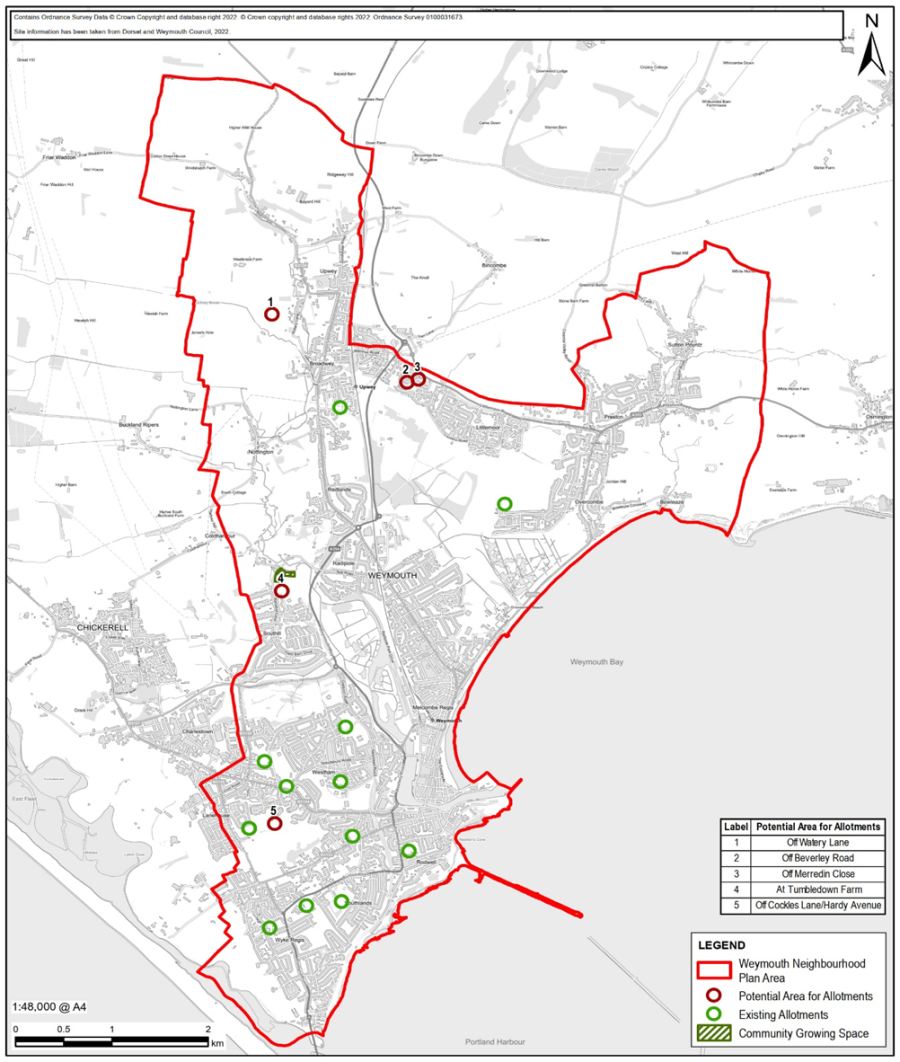
11.68 Weymouth has 14 areas of allotments. Many of them have been long-established. All are popular with local people. Ten sites are owned and managed by the Town Council comprising 358 plots. Additionally, there are two sites which are self-managed under a lease arrangement with Weymouth Town Council. There are also two private allotment areas. All these sites are protected by policy W56. The distribution of sites is heavily concentrated in the urban areas to the south and west of the neighbourhood area. Community consultation in 2022/23 has confirmed that there are notable gaps in the local distribution of allotments and community gardens, specifically in the Upwey, Broadwey and Littlemoor areas, which could be remedied, at least in part, in association with new residential development (see Map 31). The identification of suitable new allotment sites in the area from Redlands northwards towards Upwey and in the east of the neighbourhood area around Littlemoor, Overcombe, Preston and Sutton Poyntz will be encouraged and supported.
11.69 The NPPF (para. 97) encourages us to “plan positively for the provision and use of shared spaces, community facilities and other local services to enhance the sustainability of communities and residential environments”. Community horticulture facilities such as allotments encourage healthier lifestyle and healthy leisure pursuits in addition to social interaction. If the trend of providing smaller private gardens on new developments continues, it heightens the need for an increased supply of allotment or community gardening space. At January 2022 Weymouth Town Council reported having a waiting list of 101 persons for a plot on one of its ten sites.
11.70 Tumbledown Farm is a community farm in Radipole and has several growing plots for community groups. It is owned by Weymouth Town Council and run as a community partnership producing local food and delivering responsible stewardship over the natural environment that supports community life, learning and well-being in a sustainable and economic way. The project has ambitious plans to grow as a ‘community anchor’ that offers a range of activities, events, and opportunities to promote health and well-being, try new things and learn new skills and support others. Policy WEY25 of the Local Plan allocates land at Tumbledown Farm for allotments/community food provision, along with other related community uses, if the development “does not undermine the important open gap function, and the nature conservation interests, and landscape character of the site are protected and enhanced”.
11.71 Opportunities to provide more allotments, community orchards and community composting sites and encourage more local food growing initiatives similar to Tumbledown Farm should be realised. Larger housing developments should include community horticultural space whenever a potential demand is identified. A minimum soil standard should be required, to BS standard 3882:2015, for multipurpose use. This should be identified in a soil survey and soil management plan. It is our belief that given the space and some encouragement many people will respond positively.
Policy W57: New Burial Grounds
Proposals for new burial grounds will be supported in principle, subject to local need, the avoidance of significant harm to both residential amenity and the landscape and the provision of suitable access which would not cause severe danger to traffic.
11.72 The Town Council is the burial authority for Weymouth and owner of four cemeteries:
The cemeteries are managed by Weymouth Town Council in a sensitive and subtle way, in that they are not excessively manicured. Melcombe Cemetery has been designated as a Site of Nature Conservation Interest (SNCI) and Melcombe and Wyke Cemeteries have been recognised as living churchyards. Burial space will become more limited in the future.
11.73 Whilst there is a Crematorium in Weymouth, operated by Dorset Council, and cremation is the favoured practice, burial remains the preference for some, and subsequently burial space will become more limited in the future. The identification of more burial land has become a pressing issue and although Tumbledown Farm (owned by Weymouth Town Council) was included as a potential burial location in the draft Dorset Council Local Plan, this does not form part of Weymouth Town Council’s current plans for Tumbledown.
11.74 Policy W57 supports the provision of additional burial space on sites that are deemed suitable for such a purpose. Natural burial sites could be considered under this policy providing local need were demonstrated and a suitable location were identified that meets the required criteria.
108 Weymouth Character Area Assessment
109 Summary of Walkabout Notes
110 Heritage England - Weymouth's Seaside Heritage
111 Historic England - Register Search
112 Historic England - Planning Permission
113 Dorset Council - Listed Buildings in WDW&P.
115 2nd-Engagement-WNP-Consultation-Feedback-Report-October-2022
116 Dorset Council - Car and cycle parking standards
117 Dorset Council - W&P Car Parking Policy
118 Reg 14 Analysis Document - February 2024
119 Public House Viability Test - Campaign for Real Ale - January 2020
120 My Community - What are Assets of Community Value
121 Active Dorset Playing Pitch Strategy Assessment Report - March 2019
122 Active Dorset Draft Strategy & Action Plan - June 2019
123 Sports England - Design & Cost Guidance
124 Weymouth Seafront Strategy 2024-2034
< Previous | ^ Top | Next >