
6.1.1 Improving and protecting our area’s appearance and character was identified as one of the highest priorities in our Vision Survey. Making Windsor more attractive is a key objective and core principle of our NP.
6.1.2 Two messages which came through particularly strongly from our consultations were firstly that new developments are often out of keeping with the town’s heritage and character through over development and unsuitable design, and secondly that the replacement of heritage and other characterful buildings by inappropriate structures is demonstrably eroding the character of our streets. It is also true that there are examples of excellent new developments in the town which can act as a guide so that future developments fit in better. Recent evidence24 corroborates this approach.
6.1.3 Our general policies are intended to cover a range of eventualities. We mention specific sites where there is an identified issue.
OBJECTIVE 2 Conserve local character and encourage high quality design
CONTEXT
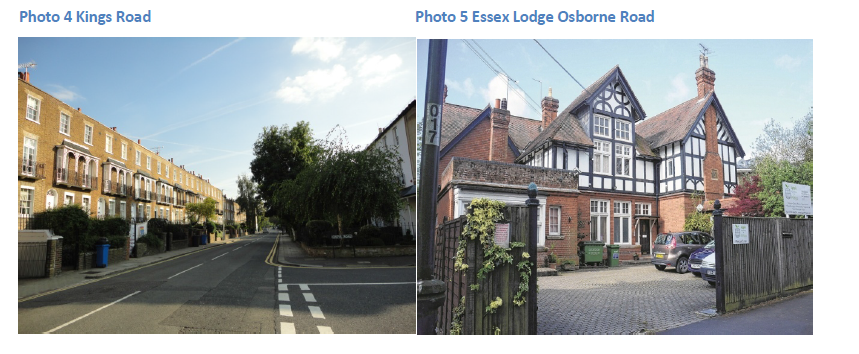
6.2.1 History and heritage is the main reason why visitors come to Windsor and our survey identified its preservation and enhancement as a key concern. The WNP area provides part of the wider setting for Windsor Castle and Great Park.
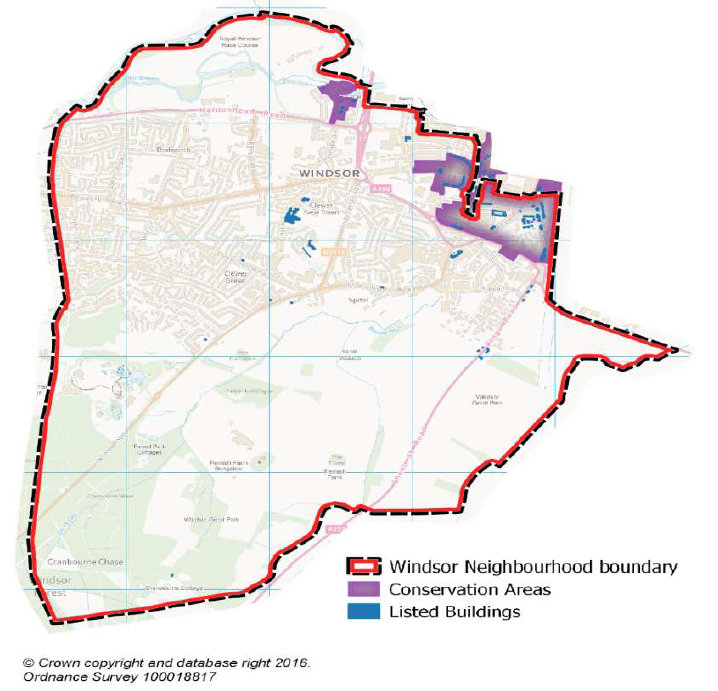
6.2.2 National policy requires the conservation of heritage assets in accordance with their significance 25. Many buildings in our area, particularly nearer the town centre, are Listed 26 as being of historic importance and this status gives them and their settings a significant degree of protection from inappropriate development. There are also three Conservation Areas within our WNP area (Inner Windsor, Mill Lane/Clewer Village, Trinity Place/Clarence Crescent) and national policy provides for the conservation and/or enhancement of Conservation Areas.
Map 9 Conservation Areas & Listed Buildings in the WNP area
Conservation Areas L-R are 1. Mill Lane /Clewer Village, 2. Trinity Place/Clarence Crescent, 3. Inner Windsor
POLICIES – Heritage Buildings and features
HER.01
Development within Conservation Areas and their settings should conserve and/or enhance local character. Development should incorporate high quality materials and have regard to the relevant Conservation Area Appraisal and Townscape Assessment, as well as to the WNP Design Guide (Appendix 2).
HER.02 – Local Heritage List
The effect of a development proposal on the significance of a non-designated heritage asset should be taken into account, having regard to the scale of any harm or loss and the significance of the heritage asset. A Local List of non-designated heritage assets is set out in Appendix 4.
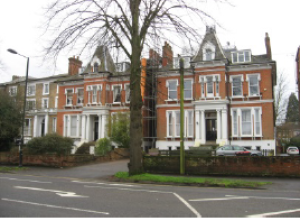
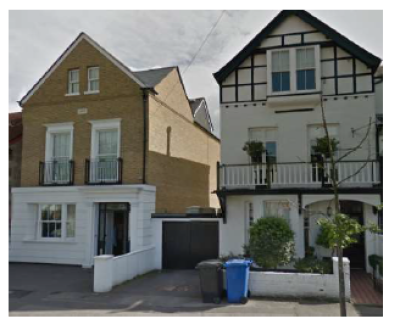
Photo 6 An Example from the Non-Designated Heritage Asset List
|
Typical late Victorian houses of wealthy businessmen or courtiers. The design is reminiscent of a French Chateau. These grand villas on the South side of Osborne Road contribute greatly to a sense of opulence and spaciousness along this stretch of the road. |
Reasoned Justification
6.2.3 National policy requires applicants to describe the significance of any heritage assets affected by proposed development, including any contribution made by their setting. To help achieve this, the Neighbourhood Forum is keen to encourage the use of the Windsor Design Guide. We wish to not only stop degradation of our historic environment but to enhance it while at the same time ensure that design can, in some instances, respond to very localised circumstances.
6.2.4 HER.02 - National policy and guidance encourages the identification of buildings and structures of local value which, although they may not meet the criteria for National Listed status, and may or may not be in Conservation Areas, do justify special attention as they help to define the sense of place.
6.2.5 These assets are called Non-Designated Heritage Assets (NDHAs). They may be “buildings, monuments, sites, places, areas or landscapes identified by local planning authorities as having a degree of significance meriting consideration in planning decisions”27 and can include amongst other things churches, and churchyards, pubs, houses. The Windsor & Eton Society, with the help of the Borough Conservation Officer, have identified a number of such buildings and structures in Windsor and is currently processing these with a view to their inclusion on a Local List of NDHAs. It is intended that this Local List will be developed and added to over the next few years. The developing list contains all the Heritage Assets identified by Conservation Area Appraisals together with other assets identified by the community.
6.2.6 The NPPF (2018) para 197 requires that a balanced judgement be taken in respect of NDHAs whether in or out of a Conservation Area. Properties deemed to be NDHA are defined on the Local List Appendix 4 of this plan, or any subsequent amendment thereof.
Context
6.3.1 Windsor is an important historic tourist town, and its appearance is key to its success. Residents and businesses are proud of it and have strong views about preserving the most attractive areas and improving those which are less attractive. Up until now, there has been little specific existing guidance for the 20th century modern suburbs that make up much of Windsor and that many people would like to see improved in terms of design and architecture.
6.3.2 Visitors should have a good experience of the town as they enter and leave and explore around, not just in the vicinity of the Castle. The more attractive the town the more people will be inclined to linger.
6.3.3 National policy28 encourages the NP to establish a strong sense of place, to seek to enforce local distinctiveness and integrate new development into the locality through “good” design. Design guides and codes and policies developed with local communities are encouraged.
Photo 7 New Houses off Vansittart Road demonstrating local architectural features
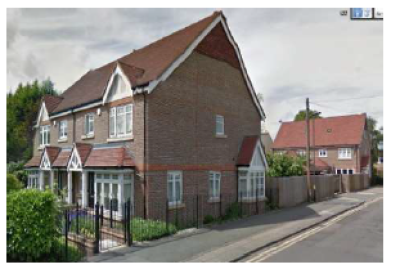
Photo 8 Alma Road. New infill house on the left in keeping with but not the same as its neighbours
6.3.4 RBWM has recently published and is consulting on a Draft Design Guide SPD (Feb 2019). It already has an approved “Townscape Assessment” (TA) and “Landscape Character Assessment” (LCA) which may be used for planning decisions and demonstrate the wide historical and architectural mix in the area, but these can be complex and difficult to use.
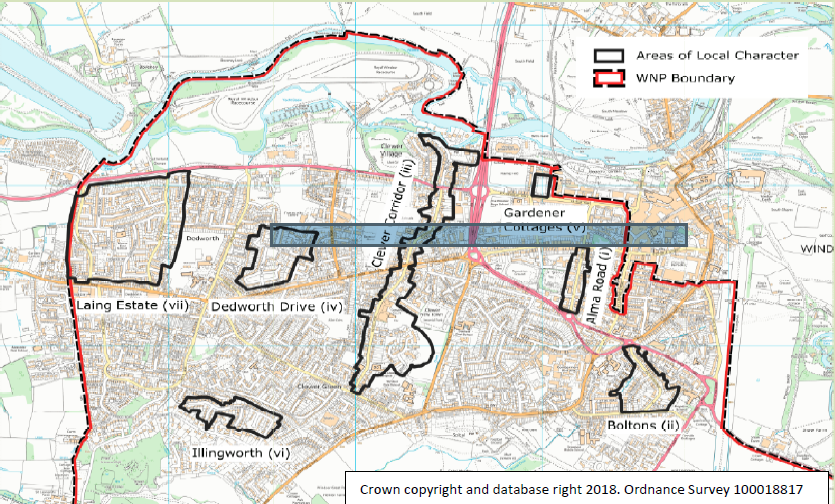
6.3.5 The WNP has identified particular pockets of distinct local character which residents have said they wish to maintain and in conjunction with the community has developed Area Character Assessments and Area Design Guides (See Appendix 2b) for these distinctive neighbourhoods.
POLICIES - Design
DES.01
Proposals for development should demonstrate how they have taken account of design guidance, including the Windsor NP Design Guide. Development affecting any of the seven areas identified on Map 10 should also demonstrate how they have taken into account the relevant NP Area Design Guide.
Map 10 Area design guides-indicative areas
6.3.6 The WNP Design Guide aims to ensure that development proposals take into account what local people consider to be good design. The guide has been developed with the help of local architects who advise RBWM and were the subject of community consultations in Jan 2016.
6.3.7 DES.01 The WNP Design Guide Appendix section 2a aims to advise applicants to take account of locally specific circumstances and encourages the use of specific additional NP guidance, the RBWM Townscape and Landscape Character assessments and Conservation Area Appraisals.
6.3.8 The guide now provides a realistic framework for developers which will also help to meet community design aspirations.
6.3.9 New development can have a positive impact on the character and appearance of the town but past developments have too often aroused negative feelings. The pressures on land, especially in the inner suburbs can lead to ‘crammed in’ developments and the lack of design guidelines has resulted in several ill-fitting developments spoiling the look of local areas. Our aim is to help developers to come forward with good quality developments which are likely to be welcomed. Our aim is to provide guidance to developers in respect of the kinds of development appropriate to different parts of the town, with the intention of helping them to ‘get it right. The Design Guides give positive examples and are not prescriptive, so allow for good modern design and ensure that design can, in some instances, respond to very localised circumstances.
6.3.10 Specific Design Guides for individual areas/streets have been created by our group, with local community involvement, based on specific Area Character Assessments in areas where there are known issues with threats to the area from cumulative impacts of developments eroding their special character, which might be for example a relatively homogenous architecture, or particular special qualities of public realm, or local historical significance.
6.3.11 We would also like to see and encourage smaller development proposals to show clearly the relationship of the proposed building in relation to neighbouring properties with accurate plan dimensions and elevations and street scene and a clear diagrammatic scale, as sometimes the information given is poor and makes accurate judgement of the impact difficult.
OBJECTIVE 2 Conserve local character and encourage high quality design
Photo 9 River Thames from Royal Windsor Way Bridge
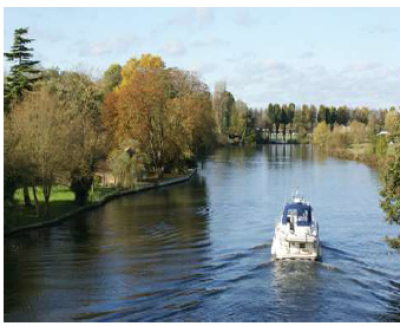
Photo 10 Windsor Castle from Osborne Road/ Chaucer Close
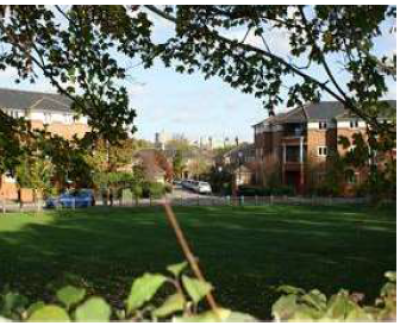
6.4.1 Windsor Castle is a strategically important landmark and the view of it creates a focus for the image and character of the whole area and providing a distinctive sense of place. Views of the silhouette and panorama of the town and castle from the approaches to Windsor create a sense of excitement at arriving at a historically important place. Our landmarks and built environment encourage visitors to come here and remind us why we like to live here.
6.4.2 The RBWM Townscape assessment29 recognises the importance of views and identifies three key views through parts of our WNP area which should be taken into account by development. These are:
6.4.3 However, it is not only panoramic views and the silhouette of the castle that are important. For residents within the town, occasional glimpses of this landmark, the River Thames and other local landmarks also add to its appeal.
6.4.4 Existing Local Plan policies say that developments must retain important views in and out of sites30. The Emerging BLP requires consideration of character and design including the Townscape and Landscape Character Assessment and of views31.
6.4.5 Best practice 32 has informed the methodology followed for the WNP areas which considers only PUBLIC views, that is views in and out of PUBLIC areas. The approach helps us to understand and protect important Panoramas, Linear views, River Prospects, and Townscape views that are available from public places.
POLICIES - Key Views
VIE.01
Development proposals must respect the Designated Views and Viewing Corridors listed below and identified on Map 11 (further information is also included in Appendix 3):
Map 11 Key Views-Local Viewing corridors
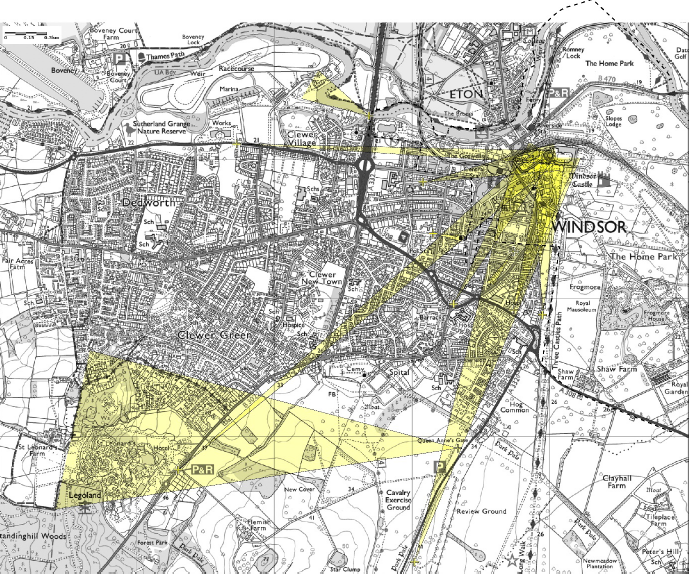
6.4.6 The Key View List and associated Local Viewing Corridors Appendix 3 identifies only views which are visible from public viewpoints at street level as opposed to “Private Views” from private land or buildings.
6.4.7 Views are selected according to the London View Management Framework criteria. That is, views must be from public places and make aesthetic, cultural or other contributions to the town, or which contribute to the viewer’s ability to recognise and appreciate the authenticity, integrity, significance, and outstanding universal value of the town’s heritage.
6.4.8 These locally important views really help to define the sense of place and are all the more important for their scarcity within the WNP area. These views change with the seasons and some can be partly obscured by trees and greenery in the summer months but become even more important in the winter when they are more obvious.
6.4.9 Views of Windsor Castle and River Thames are critical to the town’s sense of place.
6.4.10 The view from The Great Park from Sheet Street Road towards the whole of St Leonards Hill is significant in enabling a walker or visitor to the park to experience completely green surroundings from a large part of the Great Park, away from an urbanised setting. This view is visible from a whole area including along Sheet Street Road from Queen Anne’s Gate up to and slightly past the parking area overlooking the Cavalry Exercise ground. (Incidentally St Leonards Hill can also be seen as a view out from the Castle and more widely from across the Thames Valley although the aspect is different from the WNP defined view). The whole of St Leonards Hill has a blanket woodland tree protection order and the intention is to preserve the forested appearance of the whole landscape.
6.4.11 Landscape management should enable the view to be fully seen and appreciated - prudent management of trees along the viewing corridor that may otherwise obscure landmarks and any other important elements will be reviewed with key partners.
6.4.12 The application of this policy can be informed by guidance in the WNP Key Views/Local Viewing Corridors Appendix 3. This provides guidance in respect of how a view can be treated and managed. We also discuss in our Delivery and Implementation Plan Section 11 how we will seek to manage the views going forward.
24 Policy Exchange “Building More- Building Beautiful” report suggests that 85% of people want new development to blend in with what is there and people prefer Georgian terraces and Victorian mansions to concrete blocks. Other research from social enterprise group Create Streets shows that local opposition to new housing drops sharply when residents are presented with traditional human scale architecture.
25 1990 Planning Act (Listed Buildings and Conservation Areas) Para 72 General Duties for Planning authorities and the NPPF
26 Historic England Grade I or Two Listed status
27 Historic England Advice note 7 Local Heritage Listing. (May 2012)
28 NPPF- Section 12 achieving well designed places para 125, 126
29 (Urban Structure and Landscape setting of Windsor)
30 RBWM saved policy H10
31 RBWM BLP Reg 19 Policy SP3 d and e
32 London View Management Framework https://www.london.gov.uk/priorities/planning/supplementary-planningguidance/view-management
< Previous | ^ Top | Next >