The following schedule lists those saved policies from the Sutton Poyntz Neighbourhood Plan that was adopted by Dorset Council in May 2020 ( https://www.dorsetcouncil.gov.uk/w/sutton-poyntz-neighbourhood-plan) and identifies the equivalent corresponding policy (or policies) from the Weymouth Neighbourhood Plan that replaces them.
| Sutton Poyntz Neighbourhood Plan Adopted May 2020 – Policy reference and title | Weymouth Neighbourhood Plan submission version December 2024 – Policy reference and title |
|---|---|
| BNE1: Protection and Enhancement of Wildlife Habitat in relation to New Development | |
| BNE1.1 | W05: Ecological Impact of Development |
| BNE1.2 |
W05: Ecological Impact of Development W03: Wildlife Habitats and Areas |
| BNE1.3 | W04: Wildlife Corridors |
| BNE1.4 | W04: Wildlife Corridors |
| BNE2: Local Green Spaces | W11: Local Green Space |
| BNE3: Tree Preservation | W06: Trees, Woodlands and Hedgerows |
| GA1: Transport Needs and New Development | |
| GA1.1 and GA1.2 |
W07: Public Rights of Way and Access to the Countryside W46: Transport and Travel W47: Public Transport |
| GA1.3 | W55: Public Spaces |
| GA1.4 |
W50: Cycle Routes W07: Public Rights of Way and Access to the Countryside |
| GA2: On-street Traffic Congestion | |
| GA2.1 and GA2.2 | W48: Off-Street Parking |
| GA3: Impact of Traffic Density on Current Infrastructure |
W51: Traffic Impact W33: Timing of Infrastructure |
| GA4: Pollution Reduction | W49: Vehicle Charging Facilities |
| HE1: Protecting Archaeology | W45: Heritage Assets |
| H&P1: Building Style and Design | |
| H&P1.1 | W44: Design |
| H&P1.2 |
W44: Design W15: Extensions and Alterations |
| H&P1.3 | W44: Design |
| H&P1.4 |
W44: Design Annex to Appendix D – Sutton Poyntz Character Areas (and Map) |
| H&P2: Housing Numbers and Size | |
| H&P2.1 | W14: Development Boundaries |
| H&P2.2 | W17: Housing Mix |
| H&P3: Key Views | |
| H&P3.1 and H&P3.2 | W13: Panoramas, Vistas and Views |
| H&P4: Flood Prevention | W34: Sustainable Development (sub-section 2) |
| SR1: Protection of Community Assets | |
| SR1.1 |
W52: Existing Community Buildings W53: Public Houses |
| SR1.2 |
W52: Existing Community Buildings W53: Public Houses |
| SR1.3 | W52: Existing Community Buildings |
| SR2: Enhancement of Community Recreation Facilities | W54: Sports and Recreation |
Note: The Local Planning Authority may wish to refer to the supporting text relating to policies from the superceded Sutton Poyntz Neighbourhood Plan when making associated development management decisions.
Overview of the comparison between the ‘made’ Sutton Poyntz Neighbourhood Plan (SPNP) and the proposed Weymouth Neighbourhood Plan (WNP)
Biodiversity and the Natural Environment
➤ The SPNP places a strong emphasis on biodiversity protection and enhancement in relation to new development (BNE1.1 and 1.2). The corresponding WNP policies (W 03, 04, 05) are fully aligned to this intent and also strengthen the biodiversity net gain (BNG) element by referencing the mitigation hierarchy and recent legislation. Additionally the WNP policies require a higher level than the minimum statutory 10% wherever possible and on developable areas adjacent to wildlife corridors.
➤ The WNP enables the SPNP intent of greater connectivity along wildlife corridors (BNE1.3 and 1.4) to be achieved by extending and connecting the green corridor in Sutton Poyntz into the wider landscape and along the River Jordan to the sea at Bowleaze through W04 (Wildlife Corridors) and W12 (Riversides).
➤ The SPNP and WNP biodiversity policies are fully aligned with regard to application of the Dorset Biodiversity Appraisal Protocol.
➤ The seven designated Local Green Spaces (BNE 2) in the SPNP are each incorporated into WNP W10 (Local Green Space).
➤ Policies for the protection of trees and hedgerows in the respective Plans (BNE3 and W06) are fully aligned, including replacement species and site suitability criteria.
Getting Around / Transport
➤ The general intent of the SPNP policies to reduce dependency on the car and improve access through walking, cycling and public transport (GA 1.1, 1.2 and 1.4) is aligned to the more specific WNP policies (W 07, 08, 34, 46, 47, 50).
➤ The requirements of SPNP policy 1.3 in relation to adequate street lighting and walkable access are covered by W55 (Public Realm).
➤ Off Street Parking policies (GA 2.1/2.2 and W48) are directly aligned.
➤ SPNP policy GA3 relates to traffic impact from new development and is adequately covered by WNP policy 51 (Traffic Impact) and 33 (Timing of Infrastructure). The inclusion of a need to consult with communities ensures that issues specific to the local area will be addressed.
➤ SPNP policy GA4 (Vehicle Charging Facilities) is replicated by WNP policy W49 (Vehicle Charging Facilities) which extends the policy to providing publicly accessible charging points.
Heritage
➤ A direct equivalent to SPNP policy HE1 (Protecting Archaeology) exists within WNP policy W45 (Heritage Assets).
Housing and Planning
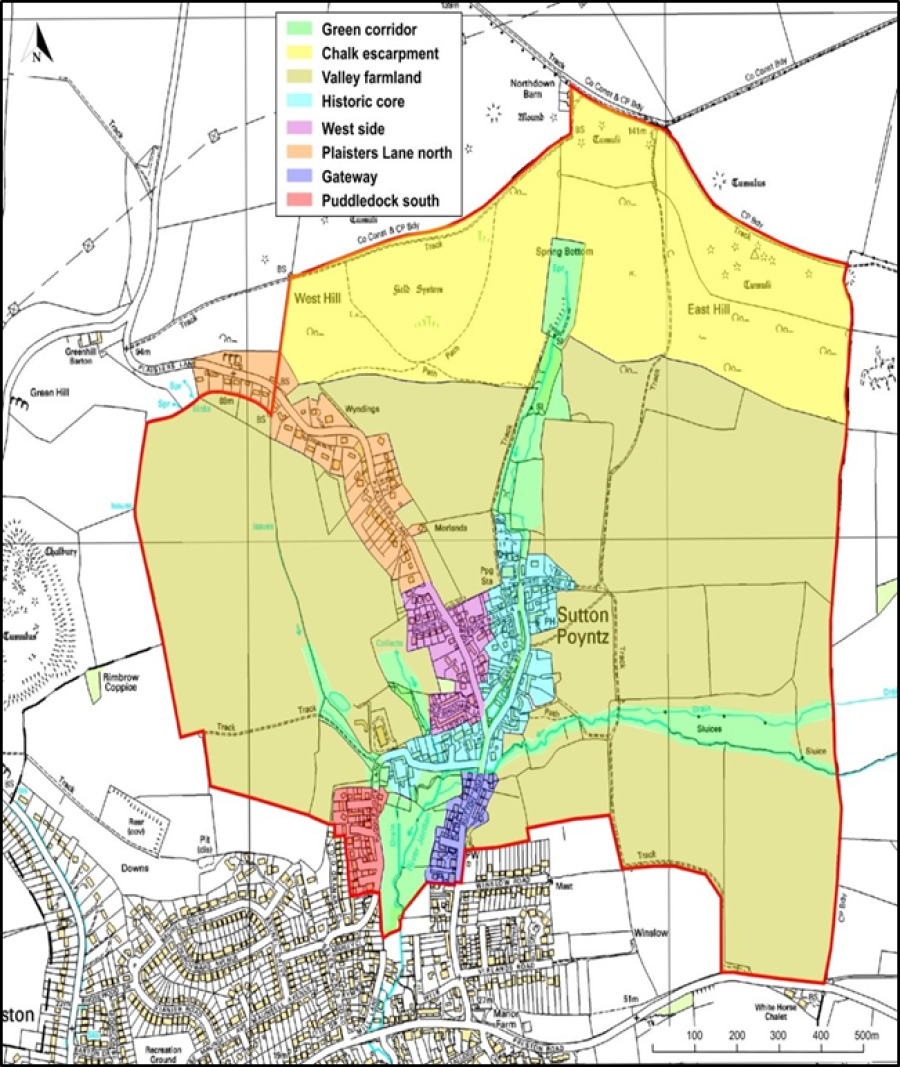
➤ SPNP policies H&P 1.1 to 1.4 address the need for new development to be complementary to the local area character and design style noting the importance of choice of materials, conservation area status and siting within the AONB whilst embracing innovative design where appropriate. Each of these issues is dealt with in a broader context by WNP policies W15 (Extensions and Alterations) and W44 (Design). Specific reference is made within the WNP to the Sutton Poyntz Character Areas and the Character Area map and descriptions are included within an Annex to Appendix D.
➤ SPNP policy H&P 2 (Housing Numbers and Size) supports development within the defined development boundary and is aligned to WNP W14 (Development Boundaries) and prioritises construction of mainly 2/3 bedroom homes in alignment with WNP W17 (Housing Mix) as specified in the supporting text and evidenced by the Weymouth Housing Needs Assessment.
➤ SPNP policy H&P 3 (Key Views) forms the basis of WNP policy W13.
➤ Concerns related to flooding are well recognised and more broadly stated in the WNP with specific equivalent reference to Flood Prevention (H&P 4) through sustainable drainage or SuDS being covered in WNP policy W34 (Sustainable Development), particularly the supporting text.
Sports and Recreation
➤ SPNP policy SR1 (Protection of Community Assets) forms the basis of the Weymouth area wide policy W52 (Existing Community Buildings) and W53 (Public Houses), the latter providing enhanced levels of protection in relation to marketing.
➤ The requirements of SPNP policy SR2 (Enhancement of Community Recreation Facilities) are covered by the broader area wide WNP policy W54 (Sports and Recreation) noting the need to engage with the local community.
CONCLUSIONS
Based upon the above cross-mapping exercise it is reasonable to conclude the following -
● There is no direct conflict between the SPNP and WNP policies
● Several SPNP policies are closely replicated in the WNP
● The WNP policies adequately cover the scope and intent of all the SPNP policies
● The SPNP policies will be superceded with policies of equal or enhanced effectiveness, both in terms of the policy and the policy intent.
ANNEX
SUTTON POYNTZ CHARACTER AREAS
Much of the village’s character is derived from the historic core. Future development should match the existing styles, scales and building materials, rather than introducing taller buildings, non-traditional materials, wider roads and pavements, and should avoid obscuring important key views or extending into the valley farmland beyond the stream banks. Protecting the aesthetic and architectural quality of the historic core is important in protecting the overall character of the village.
The West side benefits from proximity to the historic core but has a more diverse character with a confusion of styles and building materials. Several cul-de-sacs, with wide roads and pavements, strike a discordant note. Future development that better matched the historic core would enhance the overall character of the village and strengthen the sense of community.
The northerly section of Plaisters Lane offers a mixture of styles, with several houses of recognised architectural merit (47), although the plots are larger, and buildings more widely spaced than in the historic core. Any future development should be sympathetic to these important pre-war designs, while retaining established and viable trees and be consistent with the country lane feel.
Gateway marks the transition between Preston and Sutton Poyntz. The narrow lane descending into the village used to offer a striking vista of the South Dorset Ridgeway and the White Horse. Recent development, while employing traditional materials, has compromised these views and made the transition more problematic. Future development that retains the narrow lane, and offering the same high design standards, would help maintain the distinct identity of the village and protect its value to the wider community.
Puddledock South abuts Preston but does not offer the clear transition or views provided by Gateway. Development of what was previously a farm track happened quite quickly, and features pavements and wide roads. There is no sense of a narrow village lane connecting Weymouth with the countryside. Any future development should enhance the character of the area and adopt the design standards found in the historic core.
Character Areas in the Sutton Poyntz Neighbourhood Area