
Weymouth Supporting Environmental Targets
Introduction and Background
Weymouth Town Council declared a local climate and ecological emergency in 2019. It committed to making the Council’s activities net zero carbon by 2030, which included ensuring all planning comments to Dorset Council are consistent with a shift to net-zero carbon by 2030.
Following public consultation the draft Weymouth Neighbourhood Plan (5) identified and incorporated a series of cross-cutting ‘objectives’ as defined and explained within section 7, Environmental Sustainability. These are summarised below.
Environmental Sustainability |
|
Aim: To ensure development achieves or surpasses national and local agreed targets relating to the sustainable use of land and buildings, net-zero carbon emissions, improving biodiversity, and ensuring future resilience to climate change impacts |
|
Cross-cutting objective(s): Carbon Neutrality - All new developments are expected to minimise the emissions of greenhouse gases and be as near to carbon neutral as is reasonably possible Resource Efficiency - All new developments are expected to maximise the sustainable use of natural resources and the re-use and recycling of resources, and minimise energy consumption and waste Biodiversity Enhancement - All new developments are expected to include measures to conserve and enhance the biodiversity of the area Climate Change Management - All new developments are expected to result in no increase in the risk of flooding and provide adequate resilience to extreme weather events |
The cross-cutting objectives are underpinned by a series of 31 Supporting Environmental Targets (formerly called ‘Strategic Environmental Targets’) as detailed below.
Sub-section 7.6 of the draft submission version of the Weymouth Neighbourhood Plan states:
“How the cross-cutting objectives and supporting environmental targets (see Appendix A) are intended to impact on development is explained on a policy-by-policy basis in the Neighbourhood Plan. It is acknowledged that there are restrictions on the extent that high standards can be imposed by planning policy. In many instances therefore we have only been able to advocate and encourage the achievement of standards and finishes higher than are statutorily required. We must rely on the development industry to recognise what we aspire to as a community, and what we expect from new development, and urge them to work with us to achieve the cross-cutting objectives and supporting environmental targets for the sake of the town, its inhabitants, and visitors.”
Sub-section 7.7 continues: “To guide development proposals in their attainment of the cross-cutting objectives, the Town Council ‘noted’ the ‘Strategic (now renamed Supporting) Environmental Targets at Full Council on 27th September 2023. These are consistent with national policy, and based on what is considered relevant and achievable locally. They are contained in Appendix A; which must be referred to when preparing development proposals. The document presents what are considered to be acceptable and reasonable targets for each of the cross-cutting objectives in current circumstances and in the Weymouth situation. Developers will be expected to achieve and, hopefully, exceed the set targets.”
It is intended that this draft document will form the first point of reference for the ‘Supporting Environmental Targets’ referred to above.
It is further noted under sub-section 7.8 of the submission version of the Weymouth Neighbourhood Plan that: “Following Regulation 14 consultation during the Weymouth Neighbourhood Plan process a number of amendments, mainly on points of detail or clarification, were made to the ‘Targets’ document including a decision to refer to them as ‘Supporting Environmental Targets’. If adopted by Weymouth Town Council as the Qualifying Body as part of the Neighbourhood Plan they should be reviewed periodically using a recognised measurement tool and be kept up to date throughout the plan period. It should take account of changing national policy and targets; what has taken place and developers’ feedback; and what appears to be possible and achievable. But given the climate emergency, it should remain firm in intent and its duty to exert whatever influence it can on addressing the impacts of climate change and securing the future resilience of our area and communities.”
Whilst Building Regulations provide the current mandatory base standards for construction and are periodically updated they will not meet the zero carbon target aspired to by Weymouth Town Council when declaring a CEE Emergency. The Supporting Environmental Targets contained in this document whilst not mandatory represent current best practice consistent with the transition to a zero carbon future and are designed to promote sustainable design and construction with a view to delivering better quality homes with reduced running costs.
They are largely based upon information provided in the primary reference source (1) from which quantitative reference values are abstracted with further reference for purposes of alignment to the Dorset Council Sustainability statement and checklist for planning applications interim guidance note (2). In this respect it is important to note that the LETI research (1) provides alternative metrics for driving net-zero carbon design which have been adopted nationally by several local planning authorities and this guidance has also been adopted by Dorset Council (2).
For clarity and transparency key information, quantified wherever possible, has been abstracted from these reference sources in order to create these Targets. The page numbering under each target refers to the corresponding section in the LETI report (1) as appropriate and is provided for ease of reference by architects, developers, planners, installers and others to the more detailed information and secondary points of reference.
Intended Users/Usage
This document will provide guidance to a wide range of individuals, businesses and organisations as well as statutory bodies and promote a pro-active approach to sustainable design by those involved at various stages of the planning process, including:
Dorset Council (Local Planning Authority)
Weymouth Town Council
Property Developers/Owners
Businesses and Organisations
Professionals
Members of the Public
CONTENTS
| Weymouth Neighbourhood Plan – Summary of Environmental Targets | ||
| Objective 1: Carbon Neutrality | ||
| 1 | Energy Consumption | Achieve set use-related energy consumption targets |
| 2 | Zero Carbon | Meet set zero carbon deadlines |
| 3 | Renewable Energy Use | Promote renewable energy use and energy savings |
| 4 | Zero Carbon Measures | Embrace energy efficient technology |
| 5 | BREEAM Standards | Achieve high BREEAM rating |
| 6 | Insulation | High standards of insulation |
| 7 | Design and Construction | Adopt energy efficient design |
| 8 | Air Tightness | Achieve high level of air tightness |
| Objective 2: Resource Efficiency | ||
| 9 | Heating and Hot Water Systems | Adopt electric based heating and hot water systems |
| 10 | Water Usage | Minimise unnecessary water usage |
| 11 | Energy Efficient Design | Achieve set energy efficient design standards |
| 12 | Refurbishment and re-use | Prioritise refurbishment/re-use over new build |
| 13 | Usage | Design building structure for 100% utilisation |
| 14 | Recycled Materials | Prioritise materials that are re-used/reclaimed |
| 15 | Flexibility and Adaptability | Demonstrate design flexibility and adaptability |
| 16 | Carbon Sequestering | Use carbon sequestering materials |
| 17 | Retrofit Targets | Adopt set energy targets for retrofit buildings |
| 18 | Retrofit Specification | Adopt set retro-fit standard |
| 19 | Carbon Dependency Reduction | Reduce heat source carbon dependency |
| 20 | Retrofit Priorities | Prioritise retrofit measures |
| 21 | Energy Efficient Fabric | Meet set energy efficient design standards |
| Objective 3: Biodiversity Enhancement | ||
| 22 | Green and Blue Infrastructure | Meet set green/blue infrastructure target |
| 23 | Biodiversity Net Gain | Exceed minimum set Biodiversity Net Gain |
| 24 | Tree Canopy | Increase urban tree canopy to meet set target |
| 25 | Grassland Management | Achieve set management targets |
| Objective 4: Climate Change Management | ||
| 26 | Sustainable Drainage Systems | Incorporate SuDS into all new development sites |
| 27 | Waste Reduction | Minimise waste |
| 28 | Food Waste Recovery | Include adequate waste recycling facilities |
| 29 | Equipment Energy Rating | Use safe equipment which is Class A energy-rated |
| 30 | Waste Management | Include a site waste management plan |
| 31 | Sustainable Transport | Facilitate sustainable transport use |
OBJECTIVE 1: Carbon Neutrality for New Build and Retrofit |
A number of tried and tested metrics are available for quantification and the following measurement criteria are considered appropriate. In line with the LETI (1) approach it is suggested that for measurement purposes priority is given to energy use targets rather than carbon reduction targets, although the latter should not be discounted.
Energy Efficiency– [use a recognised metric for Space Heating Demand* and Energy Use Intensity**]
* amount of thermal energy that needs to be provided to the space in order to achieve a desired temperature.
** calculated by dividing the total energy consumed by the building in one year (measured in kBtu or GJ) by the total gross floor area of the building (measured in square feet or square meters).
Low Carbon Heating – [use a recognised metric to determine dependency on low carbon heating systems]
Renewable Energy Generatio – [use a recognised metric to calculate the quantity of energy generated from a renewable source]
Why set targets for buildings (see page 14 reference 1)?
Target 1: Primary energy consumption targets as summarised below should be aspired to when considering development proposals.
Table 1: Energy Consumption Targets (see page 9 reference 1)
| Parameter | Criteria | New Homes | Retrofit (for comparison) |
| Ultra low energy homes | Space heating demand+ | 15 kWh/m2 /yr | 65 kWh/m2 /yr* (on average, range of 20–120 kWh/m2 /yr) |
| Energy use and efficient heating | Energy Use Intensity++ | 35 kWh/m2 /yr | 60 kWh/m2 /yr* (on average) |
| Renewable energy | Electricity generation intensity+++ | 120 kWh/m2 /yr per m2 of building footprint | 120 kWh/m2 /yr per m2 of building footprint* |
| Embodied carbon | Embodied carbon benchmark++++ | 500 kg CO2e/m2 /year |
Notes
+ the amount of heat energy needed within the home to maintain the rooms at the desired temperature.
++ the amount of energy used per square metre annually.
+++ how many grams of carbon dioxide (CO2) are released to produce a kilowatt hour (kWh) of electricity.
++++ all the emissions from the construction materials, the building process, all the fixtures and fittings inside as well as from deconstructing and disposing of it at the end of its lifetime.
*Note: This figure will depend upon a number of factors and is based upon 1m2 of an averagely efficient solar panel (20%) in optimal conditions for a UK location.
In simple terms electricity generation intensity needs to exceed the combined energy use intensity and space heating demand before target 2 is achieved.
Other building types tend to vary more widely than housing, making it more difficult to reliably determine generic forms, energy use or occupancy models. However, the RIBA, LETI, the UKGBC and other organisations have published relevant guidance on performance targets for space heating demand, total energy use and renewable generation as summarised below (see page 37 reference 1).
Schools
Hotels
Offices
Light Industrial
Target 2: Achieve Zero Carbon within the period of the Neighbourhood Plan (see page 10 reference 1)
Focus for achieving the target – increase renewable energy generation with a primary focus on photovoltaic panels based on the following hierarchy: Existing public buildings; new public buildings; existing residential buildings; new residential buildings; existing commercial buildings; new commercial buildings; sites on low grade agricultural land (Grade 3b and 4).
MCS certified installers to be used.
Check current HM Government solar photovoltaic cost data, for example at 2022 costs - small systems about £1500 per kilowatt and £1100 per kilowatt for large systems. Consider a ‘solar tenant model using sub-meters’ for blocks of flats and similar residential accommodation, and micro-inverters to increase output by up to 15%.
Target 3: Energy use/demand is equal to or less than renewable energy generation by 2030.
(see page 10 reference 1)
Focus for achieving the target - support measures to reduce energy use/demand (e.g. enhanced insulation standards) and promote renewable energy generation (primarily photovoltaic panels, community energy schemes). Promote energy saving and storage through installation of smart controls (reduce usage at times of peak demand) and energy storage measures (e.g. hot water storage, batteries subject to cost viability).
Target 4: A 2 to 6% zero carbon cost premium on new buildings is acceptable when the estimated energy use savings exceed 30% (35 to 40% achievable for a terraced house and 50% for a small block of flats).
(see page 11 and 32 reference 1)
Focus for achieving the target - Additional costs at the build stage can be divided into four categories and the investment assessed against the on-going running costs.
1. Energy efficiency e.g. Better insulation, Triple glazed windows, Airtightness, Mechanical Ventilation with Heat Recovery, etc.
2. Low carbon heat e.g. Heat pump system.
3. Solar generation - Roof mounted solar Photovoltaic panels.
4. Demand flexibility - Hot water storage, Smart controls.
Target 5: Set BREEAM standards as the primary target for sustainable build with an overall aim of BREEAM Excellent and promote the assessment of build quality to this recognised standard.
Focus for Achieving the Target - The BRE Environmental Assessment Method, BREEAM, is a voluntary assessment method used to describe both new and existing buildings’ environmental performance. The method originated in the UK, but buildings built outside the UK can also be assessed using BREEAM: International. There are standard versions of the assessment for all building uses including homes, retail and business.
The assessment works by giving a building a score based on its performance against a series of set criteria. There are two assessment stages: a design stage assessment that leads to a provisional rating followed by a post construction assessment leading to the final rating. The building’s score will establish its BREEAM rating. BREEAM “Outstanding” is the highest rating, followed by Excellent, Very Good, Good, Pass and Unclassified.
Whatever the rating there are minimum standards that must be achieved across a range of factors including carbon emissions, waste and potable water. Extra credits are awarded for design innovations that will reduce a building’s impact on the environment in an innovative way.
Accreditation to BREEAM standards can provide a number of benefits to developers, for example, enhanced reputation and improved saleability potential as well as a clear statement of credibility on sustainability.
Target 6: Prioritise enhanced insulation (fabric first approach). Assess the fabric efficiency by determining the space heating demand.
(see page 14 reference 1)
Focus for achieving the target - Adopt the Key Performance Indicators for new housing as per Table 1 and work towards the ‘Passivhaus’ standard.
Guide figure for space heating demand is 15 kWh/m2.year for new build and 25 to 50 kWh/m2.year for retrofit.
Reference should be made to the Low Energy Transformation Initiative (LETI) Guide (1) for greater detail.
Target 7: Adopt design and construction criteria that focus upon built form, building orientation and window to wall proportion so as to increase energy efficiency without adding construction costs.
(see page 5-16 reference 1)
Focus for achieving the target - Form – simple, compact, minimum or non-stepped roofs, roof terraces, overhangs or inset balconies.
Orientation – maximise solar gain (south facing) / prevent overshadowing in winter, use solar shading and reflective surfaces to reduce summer temperatures in and around buildings, and use dual aspect for maximum air cross flow.
Windows – use smaller windows on the north side and larger windows on the south side, orientate access to decks to the north and balconies to the south. Aim for a whole unit U value of Uw less than 1.4 W per square metre K for double glazing and 0.85 for triple glazing. UPVC and timber frames are strongly preferred to metal. Avoid thermal bridging. Maximise the glazing to frame proportions.
Doors – Aim for a whole door Uw value of maximum 1.0 W per square metre K.
Allow 1 to 1.5 times the building height between buildings.
Favour low energy construction methods.
Reduce variable quality of insulation installation through use of closed panels, off-site quality-controlled construction, etc.
Ensure that a checklist for design and installation verification is a mandatory requirement.
Target 8: Aim for air tightness of less than 1.0 (and no more than 3.0) cubic metre per hour per square metre (see page 19 reference 1)
Focus for achieving the target – test for leak during construction, avoid trickle vents, install high specification mechanical ventilation with inbuilt heat recovery unit, provide opening windows.
Avoid overheating by adopting the following design guidance -
OBJECTIVE 2: Resource Efficiency for New Build and Retrofit |
The correct choice and efficient use of resources is critical to achieving the zero carbon target both in relation to initial build and on-going operation and will present particular challenges with retrofit projects and heritage retrofit more so. Addressing these will begin with the decision to demolish or refurbish, the adoption of a fabric first approach in which sustainable insulation is key, the choice of primary heat source, minimising waste energy and materials, making buildings adaptable for future modification and ease of maintenance, as well as thinking about end of life considerations.
Target 9: Adopt electric based heating and hot water systems with preference for heat pumps as the primary heat source and ideally powered by photovoltaic panels to maximise efficiency whenever home heat demand is less than 100 kilowatt hour per square metre /year. (see page 20-24 reference 1)
Focus for maximising heating efficiency – heat pumps need to be sized correctly with a high coefficient of performance, use propane as the preferred refrigerant, minimise pipe runs, increase radiator size, supply clear user information. It is recommended that communal heating schemes use an ‘Ambient Loop System’ to maximise efficiency.
In new build avoid gas boilers, open fireplaces, extraction only vent systems, domestic wind turbines and trickle vents. Prioritise triple over double glazing.
Such an approach supports the principle of taking an insulation first approach to reduce demand below 100 kilowatt hour per square metre per year before installing a heat pump in order for it to become an effective means of heating. It is then much more cost effective to power the heat pump from on-site photovoltaics as opposed to an externally provided electricity supply.
Target 10: Aim for a maximum water usage of 110 litres per person per day (consider Environment Agency recommendation of 95 litres per person per day (4)). (see page 25 reference 1)
Focus for achieving the target – reduce hot water usage by reducing flow rates to showers and taps to meet AECB standards (see Table 2), insulate/design pipework to minimise distribution losses, insulate hot water tanks to reduce loss of heat to below 1 kilowatt hour per day, install waste water heat recovery systems in shower drains, consider waste water recycling e.g. grey water WC flushing, waste water capture.
Table 2: AECB Water Use Efficiency Standards
| Appliance / Fitting | AECB Good Practice Fittings Standard |
| Showers |
6 to 8 l/min measured at installation Mixer to have separate control of flow and temperature or single lever with lift (flow) and rotate (temperature) Clear indication of hot and cold Hot tap or lever positioned to the left where relevant |
| Basin taps |
4 to 6 l/min measured at installation (per pillar tap or mixer outlet) Clear indication of hot and cold Hot tap or lever positioned to the left |
| Kitchen sink taps |
6 to 8 l/min measured at installation Clear indication of hot and cold Hot tap or lever positioned to the left |
| WCs |
≤ 6 litres full flush with water supply connected All domestic installations to be dual flush Valve-flush mechanism (not siphon) Fitted with an easily accessible quarter-turn isolating valve with hand-operated lever Home User Guide must include leak testing and repair information |
| Baths |
≤ 180 litres measured to overflow centre line (excluding bather displacement) Shower must also be available If over bath, must be suitable for stand-up use with screen or curtain |
Target 11: All new build fabric including extensions to meet the energy efficient design standards as summarised in Table 3 below.
Table 3: Overview of Energy Efficient Design Standards (New Build)
(see page 9 reference 1)
| Design Standard | New Terraced House | Small Block of Flats (6–8 units) |
| Air tightness (m³/hour/m²) | 1.0 | 1.0 |
| Roof - Thickness insulation | Pitched: 400 to 450 mm | Flat: 1000 to 1100 mm |
| Roof - U value (W/m².K) | 0.10–0.12 | 0.10–0.12 |
| External Doors - U value (W/m².K) | 1.0 | 1.0 |
| Ground Floor - Thickness insulation | 150–200 mm | 150–200 mm |
| Ground Floor - U value (W/m².K) | 0.08–0.10 | 0.08–0.10 |
| Walls - Thickness | 550–600 mm | 550–600 mm |
| Walls - U value (W/m².K) | 0.13–0.15 | 0.13–0.15 |
| Windows - U value (triple glazed W/m².K) | 0.8 | 0.8 |
| Thermal Bridging # (Y value W/m².K) | 0.04 | 0.04 |
# Weak points (or areas) in the building envelope which allow heat to pass through more easily.
Target 12: Prioritise refurbishment/re-use over demolition and new build
(see page 29 reference 1)
Forward looking planners are adopting a presumption against demolition. Where substantial demolition is proposed, applicants must demonstrate that the benefits outweigh retaining the existing structure.
At an early stage, compare historical and current figures as a baseline and adopt a Whole Life Carbon Assessment approach.
Target 13: Design the building structure for 100% utilisation
(see page 29 reference 1)
Determine this at the design stage in consultation with architects, builders and professionals.
Focus for achieving the target – Discuss with architects, builders and other professionals, factors such as reducing spans and overhangs, reduce quantity of metal studs/frames, minimise long duct runs and leakage, specify low GWP refrigerant (maximum 150).
Target 14: Prioritise materials that are re-used/reclaimed; natural and from the local area, sustainably sourced and durable. Use a high recycled content as a secondary option.
(see page 29 reference 1)
Focus for achieving the target– Apply the following hierarchy ( 1 is preferred to 4 least preferred);
Apply BSEN 15804 to compare environmental impacts.
Target 15: Demonstrate design for flexibility and future adaptability and provide for ease of access for maintenance and disassembly to allow re-use at the end of life (material passports)
(see page 29 reference 1)
Focus for achieving the target
Discuss with architects, builders and other professionals choices that will help achieve this outcome.
Increasingly building design will have to adapt to address our changing climate and it is expected that planners will need to adopt new techniques. Examples are multiple slopes on roofs, rounded walls and optimum aerodynamic orientation to reduce wind energy impact in exposed locations. Other techniques to be considered are frangible design approaches where balcony or patio roofs are designed to break in extreme storm conditions.
Weymouth is faced with a significant flood risk and increasingly will need to build on elevated sites or elevate the buildings themselves.
Target 16: Use 100 percent carbon sequestering materials for insulation.
(see page 30/31 reference 1)Focus for achieving the target – Use materials such as sheep wool, cellulose from recycled paper, cork, hemp. Internal insulation should be of an open/breathable type.
Target 17: Adopt the Energy targets in Table 4 for Retrofit buildings.
(see page 40 of reference 1)
Table 4: Energy Targets (Retrofit).
| Parameter | Criteria (see definitions in Table 1) | Retrofit |
| Ultra low energy homes | Space heating demand | 65 kWh/m²/yr* *on average (range 20–120 kWh/m²/yr) |
| Energy use and efficient heating | Energy Use Intensity | 60 kWh/m²/yr *on average |
| Renewable energy | Electricity generation intensity | 120 kWh/m²/yr* m2 building footprint |
Target 18: Adopt Publicly Available Specification (PAS) 2035:2019 retrofit standard for design and PAS 2030:2019/2020 for retrofit installation.
The targets are aligned with PAS 2035 which is the current level of retrofitting to achieve EPC 'C' in all domestic dwellings by 2035.
(see page 42 reference 1)
Target 19: Reduce heat source carbon dependency for retrofit based upon the prioritisation map in Table 5 below. (see page 44 of reference 1)
Note: An EPC rating 'C' is 66-100 kWh/m2/year. A 'B' is 33-65 kWh/m2/year. This is total demand per m2 per year. An Air Source Heat Pump needs to be installed in a house in that range to be effective.
Note: Each house or flat is different and will have different starting and final positions on the ‘Map’ below but ultimately, by 2050? (or earlier) all homes must be moved to one of the green squares. The ‘Map’ should also be used to identify the buildings which need to be most urgently retrofitted (in red) as they will be consuming most of the carbon budget. Other factors (e.g. maintenance schedules, replacement opportunities, resident compliance) may also influence the prioritisation.
Table 5: Heat Source Decarbonisation Priorities for Retrofit.
| Fabric and Ventilation |
Low
Energy
High
|
Individual or communal gas boiler | Direct electrical heating | Low carbon heat network | Heat pump system | |
| Heating demand <40 kWh/m2/yr | ||||||
| Heating demand <100 kWh/m2/yr | ||||||
| Heating demand <150 kWh/m2/yr | ||||||
| Heating demand >150 kWh/m2/yr | ||||||
| Heat Decarbonisation | ||||||
| Low Carbon | High Carbon | |||||
Key
RED - Use of fossil fuels. Not compatible with Net Zero. The heating system must be changed.
YELLOW - Low carbon heat but risk of high energy costs. A change of heating system may not be required but fabric, ventilation and system should be improved.
GREEN - Low carbon heat and sufficient level of energy efficiency. Compatible with Net Zero.
Improve energy efficiency through insulation then
Install low carbon heating systems then
Install renewable energy production on site, then
Make ‘Smart’ ready for a compatible interface with emerging technologies
(see page 45/46 reference 1)
Focus for achieving the target – Adopt a fabric first approach: commit to the first principle of no insulation without ventilation (ideally MHVR), adopt a preference for external insulation where possible, for internal insulation use vapour open types (e.g. wood fibre).
The LETI publication ‘Retrofit at Scale’ (9) provides detailed guidance on practical retrofit solutions and cost reduction measures.
Target 21: All retrofit fabric changes to meet the energy efficient design standards as summarised in Table 6 below. (see page 41 reference 1)
Table 6: Overview of Energy Efficient Design Standards (Retrofit)
(see page 63 and 68 to 76 reference 1)
| Design Standard | Typical Retrofit Terraced House |
| Air tightness m3/hour/m2 | 2.0 |
| Roof U value W/m2.K |
Pitched 0.12 |
| External Doors U value W/m2.K |
1.0 |
| Timber Floor Insulation U value W/m2.K |
Under or over floor 0.2 |
| Walls Insulation U value W/m2.K |
Additional internal or external 0.32 |
| Windows U value W/m2.K double glazed |
1.3 |
| Thermal Bridging Y value W/m2.K |
0.10 |
When considering Heritage Retrofit (see page 47 reference 1) adopt the following principles
Energy efficient measures will help to reduce costs and help maintain the fabric of the building from the effects of damp etc.
Due to the complexity of factors involved specific targets are not normally set but general retrofit standards and principles should form the basis of the move to net zero carbon in these buildings using sympathetic and innovative solutions as appropriate (see ref 3).
When considering Heritage Retrofit (see page 47 reference 1) adopt the following principles
Energy efficient measures will help to reduce costs and help maintain the fabric of the building from the effects of damp etc.
Due to the complexity of factors involved specific targets are not normally set but general retrofit standards and principles should form the basis of the move to net zero carbon in these buildings using sympathetic and innovative solutions as appropriate (see ref 3).
OBJECTIVE 3: Biodiversity Enhancement |
Retention of existing habitat such as trees, hedgerows and dry stone walls as well as the creation of complementary and appropriate new habitat such as wildlife rich gardens, wildflower verges, and green roofs and walls, supported by environmentally sustainable features e.g. bat and bird boxes/bricks and hedgehog highways are critical to achieving biodiversity net gain enhancement.
The Environment Act 2023 identifies a minimum 10% Biodiversity Net Gain requirement for new development sites. The Dorset Council draft Local Plan promotes the conservation and enhancement of biodiversity habitat. The draft Weymouth Neighbourhood Plan underpins and develops these initiatives at a local level through policies that protect, conserve and enhance wildlife habitat, most notably WNP 02 (Protection and Enhancement of Wildlife Habitats and Areas), 03 (Areas of Nature Conservation), 04 (Landscape and Wildlife Corridors), 05 (Ecological Impact of Development) and 06 (Trees Woodlands and Hedgerows).
Consistent with these policies the following Supporting Environmental Targets are proposed.
Target 22: All new development should incorporate sufficient (minimum 10% of the total site area) green and blue infrastructure.
Benefits – trees and hedges will absorb carbon from the air, assist water retention through to structures, connect with existing green infrastructure so as to create wildlife corridors. They will also benefit people in terms of shading and cooling of buildings, provide effective surface water management and contribute to health and wellbeing. Incorporation will assist developers in meeting statutory Biodiversity Net Gain requirements.
The contribution of the soil and the undertaking of groundworks during development is generally overlooked in terms of carbon release and sequestration with on-going impacts well beyond the life of the construction phase that have a detrimental effect on biodiversity and the well-being of people, for example due to flooding or lack of soil fertility. These can be easily addressed through a soil survey and management plan (15) leading to mitigation measures such as soil protection zones, segregation of sub and top soils and prevention of sediment run-off.
Blue infrastructure such as sustainable drainage features e.g. basins and ponds and the retention of natural features such as streams, culverts, reed beds and floodplain meadows can provide both wildlife habitat and contribute to human health and well-being.
Target 23: A minimum 20% Biodiversity Net Gain shall be required on all new development sites, with the highest priority given to those immediately adjacent to wildlife corridors.
This target recognises that the statutory requirement is for a 10% minimum, reflects the ecologically sensitive environment (both inland and coastal) and supports the call by the UK Environment Agency for 20% Biodiversity Net Gain (BNG) in response to the Dorset Council Local Plan consultation 2021 (4) and acknowledges the evidence base of the Guildford study (8). It particularly recognises the sensitivity and vulnerability of wildlife corridors to adjacent development and supports the Dorset Council Natural Environment Team approach to a higher level of BNG on such sites.
Target 24: Increase in urban tree canopy cover from 9.8% to a minimum of 15% (6)
Weymouth Town Council’s 5,000 tree stock includes 118 different species planted across 80ha of open space. The Council has pledged to reduce its carbon footprint by 2030 and to offset its emissions the Parks & Open Spaces team are committed to increasing the Council’s tree stock by 1000 over a period of five years (2021 - 2025). There have been 800 trees planted since 2021 across a number of Town Council owned sites in Weymouth and the remainder are on target for the end of 2025.
In order to help achieve the target key sub-targets are as follows -
Target 25: Grassland Management and restoration (7)
Key quantifiable targets -
Conduct scrub and hedgerow management:
OBJECTIVE 4: Climate Change Management |
Extreme weather events intensifying across the globe present an urgent need to adapt our buildings, infrastructure and communities to the impacts of the climate emergency. From extreme heat in our summers to repeated flash flooding across the UK, 60% of the UK’s climate-related risks are currently rated in the most severe urgency category. It is recognised that there is a need to set science based targets and measurable metrics for climate resilience which at the time of writing are not available but are expected to become so during the life of the Weymouth Neighbourhood Plan and will be a matter for review.
The measures outlined in Targets 1 to 25 will each contribute to climate change management to varying degrees. Other factors do however need to be considered. Significant for Weymouth are the effects of coastal and surface water flooding. Coastal management is a strategic issue addressed through the Shoreline Management Plans as per W01 of the draft Weymouth Neighbourhood Plan (5). The topography of the area in which steep calcareous grassland with little vegetation and multiple underwater springs create excessive surface water run-off into the chalk bed rivers of the lower valleys and then enter the sea creates a significant flood risk, particularly at times of high tide. Whilst some of these contributing factors cannot be controlled at source and mitigation is necessary, other contributors to floodwater generation such as run-off from impervious surfaces within new developments can be addressed.
Additionally food and general waste management will be key to reducing carbon as will the move towards more sustainable modes of transport.
These other factors are outlined and where possible quantified below.
Target 26: Sustainable Drainage Systems (SuDS) must be incorporated into all new development sites irrespective of size unless assessed as inappropriate for reasons of increased adverse environmental impact. Natural features and materials are preferred to artificial means of control.
Focus for achieving the target – All SuDS installations must apply the hierarchy of drainage options with priority being given to greenfield run off and installation as close to the source as practicable.
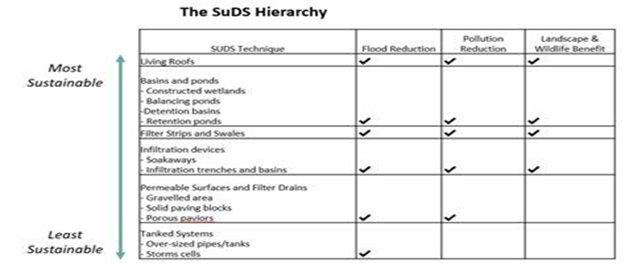
Small to larger scale options for rainwater harvesting should be considered as appropriate to development sites (both new build and retrofit projects) whilst area scale options such as management of floodplain meadows and former water meadows should also be considered where practical as they occupy a position at the top of the hierarchy. Similarly on an apartment scale, living (green) roofs offer options for Town Centre developments and provide a number of other benefits such as supporting plant growth, providing insulation and reducing energy demand by cooling in summer and reducing heat loss in winter.
All surface water management systems must ensure the separation of surface water and sewage discharge. SuDS schemes will also present significant opportunities to incorporate features that will benefit wildlife through the creation of habitat stepping stones and buffer zones and may even form part of wildlife corridors
Target 27: All waste to be managed according to the typical basic hierarchy below.
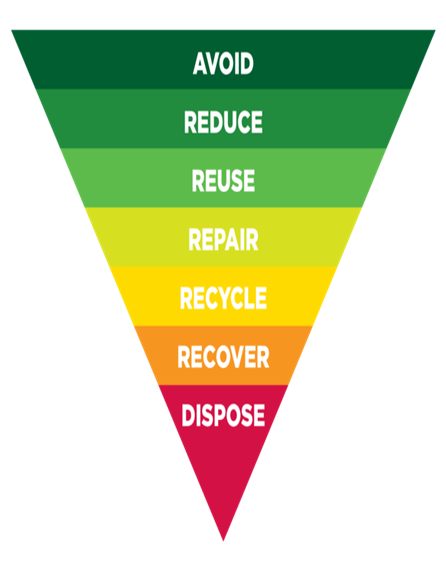
Focus for achieving the target – prioritise compliance with the hierarchy in public buildings /facilities and town council contracts with suppliers/leaseholders. Then inform and advise residential and commercial premises.
All new buildings, extensions and retrofitted buildings must incorporate adequate indoor and outdoor storage facilities into the design to allow occupiers to separate and store waste for recycling and recovery.
Local authority support for community repair shops, recycling schemes and waste processing facilities are examples of investments in sustainable living and can contribute significantly to surpassing the targets below.
The aim should be to exceed the key targets in the UK Waste Management Plan (11) by 2035 of preparing for recycling/re-use 65% of all municipal waste and reducing municipal waste to landfill to 10% by weight of the total.
The Resources and Waste Strategy identifies five strategic ambitions:
Once again, the aim should be to exceed these targets.
Target 28: All food waste to be managed according to the food recovery hierarchy below.
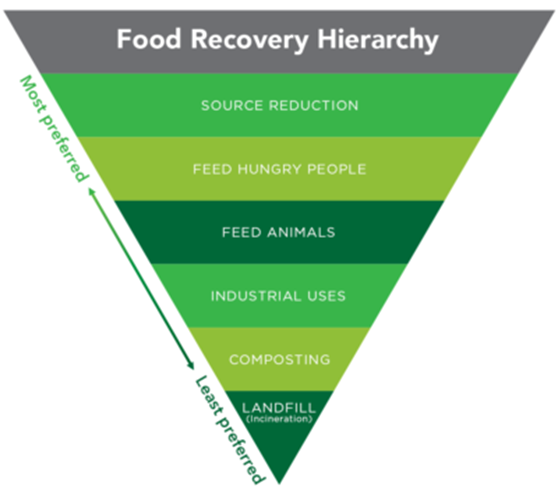
Focus for achieving the target – Food waste is a significant concern at time of a cost of living crisis and application of a food recovery hierarchy by businesses and homes can do much to alleviate this. There are also opportunities for local authorities to prioritise compliance with the hierarchy in public buildings /facilities and town council contracts with suppliers/leaseholders as well as to inform and advise residential and commercial premises.
The aim should be to exceed the UK Government target of eliminating food waste to landfill by 2030. (11) through application of the typical food recovery hierarchy above.
Target 29: Choose equipment (machinery, apparatus, tools, appliances) and fittings which are safe, minimum Class A energy rated, durable, repairable, re-usable.
Focus for achieving the target – These standards should be adopted when fitting out new and retrofit buildings. Also prioritise compliance for direct or indirect local authority provision or use, then inform and advise residential and commercial premises.
Target 30: All construction and demolition contracts to include a Site Waste Management plan.
Focus for achieving the target – as a minimum a Site Waste Management Plan must show how it is planned to minimise waste during construction and demolition, the types and quantities of waste generated and specific measures for managing the waste which align with the waste hierarchy (see Target 27).
Target 31: Facilitate sustainable transport use in all new/retrofit properties through provision of individual electric vehicle charging points, integrated cycle storage, sufficient service connection points for home working.
Focus for achieving the target – The Weymouth Neighbourhood Plan policies as implemented by the Local Planning Authority will form the primary focus for achieving these target measures. Simple planning solutions exist such as the provision of public services and public transport close to homes, places of employment and leisure, such they can be accessed easily by walking and cycling so as to reduce dependency on use of the car. This is illustrated in the hierarchy below (13) where digital communication is at the top of the hierarchy as it eliminates the need to travel and air travel (particularly long haul) sits at the bottom due to the very high production of carbon dioxide. Human effort is preferred to passive mechanical systems and public transport prior to personal transport with electric vehicles being preferred over fossil fuel driven internal combustion engines.
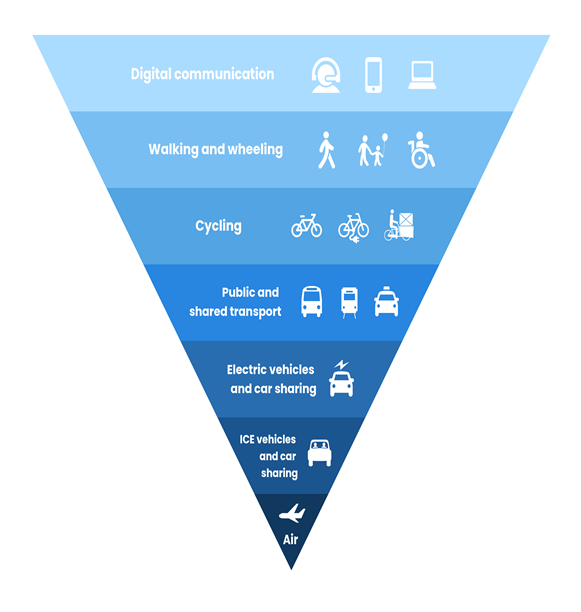
Much can be done to encourage walking and wheeling.
The Ramblers Charter (12) as adopted by Weymouth Town Council at the full council meeting on 16th October 2019 underpins sustainability in terms of ‘walkable neighbourhoods’ and sets five key principles -
Local authorities have in recent years set a range of distance criteria for ‘walkability’ (10); the following distances from a neighbourhood centre are typical and provide a useful reference point.Key services e.g. Surgeries, Food Shops, Social Hubs - within 800 metres (10 minutes single journey); Bus stops – within 400 metres (5 minute single journey); Primary schools – within 800 metres; Green space over 2 Ha – within 1 kilometre (12 minutes journey); Play parks and small open spaces – within 400 metres.
References
(1) Net Zero Carbon Toolkit published by London Energy Transformation Initiative (LETI) October 2021.
(2) Sustainability statement and checklist for planning applications Interim guidance note Dorset Council, December 2023.
(3) Listed Buildings, What you can do for climate change published by Dorset Council.
(4) Environment Agency response to the Dorset Local Plan consultation - 15/03/2021 Dorset Council.
(5) Weymouth Neighbourhood Plan draft version 1.5 April 2023 published by Weymouth Town Council.
(6) Tree Management Policy 2021 – 2025, published by Weymouth Town Council.
(7) Parks and Open Spaces Biodiversity Policy 2021 – 2025, published by Weymouth Town Council.
(8) Guildford Borough Council: Biodiversity Net Gain; Evidence Base for Policy Development, Biodiversity Net Gain Study for Approved Developments. Published by Stantec on behalf of Guildford Borough Council, October 2022.
(9) Retrofit-at-Scale: Upgrading our homes to meet UK climate energy targets. Published by LETI July 2024.Retrofit at Scale – Sustainable Development Foundation
(10) Walkable neighbourhoods Building in the right places to reduce car dependency Published by SUSTRANS 16th May 2022.
(11) Waste Management Plan for England, DEFRA, UK Government January 2021.
(12) The Ramblers Charter for Walking Neighbourhoods (adopted by Weymouth Town Council 2019).
(13) An introduction to the sustainable travel hierarchy, Energy Saving Trust, April 2024.
(14) Whole life carbon assessment for the built environment RICS PROFESSIONAL STANDARD Global 2nd edition, September 2023 Version 3, August 2024 Effective from 1 July 2024 Whole life carbon assessment PS Sept23.pdf
(15) Building on soil sustainability: Principles for soils in planning and construction; Soils in Planning and Construction Task Force Sept 2022 https://wp.lancs.ac.uk/sustainable-soils/files/2022/09/Soils-in-Planning-and-Construction-Sept-22.pdf
Weymouth Neighbourhood Plan Steering Group July 2023
Reviewed and revised October 2024
< Previous | ^ Top | Next >