
Eton College is the principal employer and landowner within the town. The success of the College and the vitality of the town are intertwined. The continuing character of the Town is largely dependent upon the College and so this plan recognises that the College will need to carry out building developments. Such developments will be supported wherever possible to maintain the sustainability and viability of the College.
Part of Eton’s character is defined by the presence of small businesses and retail premises clustered along the High Street. Windsor Bridge was closed to traffic in 1970 and is now pedestrianised, serving as the gateway into Eton’s retail areas from Windsor. This area provides a multitude of shops, services, leisure and administrative uses to meet the day-to-day requirements of Eton and Eton Wick residents, workers, visitors and tourists. Along with Eton College, it is an important source of local employment and therefore plays a role in ensuring economic sustainability in the Neighbourhood Plan Area.
Eton’s significance as a commercial and cultural centre has been highlighted by the Eton Walkway project – a series of celebratory plaques that emphasise the history of the town. The aims of this project, some of which are listed below, set out a framework of general goals that business, leisure and tourism proposals can aspire to:
Eton Wick, by contrast, has a retail centre that functions differently to Eton. However, the business and leisure facilities that are present in the village provide an essential asset to the community, and save a lot of time and travel for residents who would otherwise have to travel elsewhere for everyday essentials. Eton Wick is historically a farming village and to this day, the village retains a portion of its agricultural economy and character, but to a far more modest extent. Today, Eton Wick is home to an increasing number of professional families who recognise the area as being ideally placed to commute from and an opportunity to live in a village nestled in a rural environment and benefiting from various designations such as Common Land and Green Belt (which conserve the character of the village).
Good retail environments directly serve the local community through their convenience and service but should also offer other benefits such as supporting the tourism industry, and offering social spaces where the community might meet. The core aspirations of this chapter are to encourage sustainable business growth in our neighbourhood that capture the economic, social and cultural benefits that good local business can offer. In Eton this means preserving and enhancing the existing businesses, whilst in Eton Wick there is potential to improve the retail environment and quality of shops in the area. Tourism is important for Eton’s sustainability;
Visitors come from far and wide to visit nearby Windsor and some come to Eton. Eton Wick attracts rural visitors, for example walkers and social cyclists.
The community supports initiatives to bring back facilities and services into good use through planning and community organisation interventions. For example, the plan supports initiatives by the Town Council to take an ongoing approach to monitoring underused or unviable facilities. The Town Council are best placed to play a role in mediating between different community needs and proposing holistic solutions that fit within the objectives of this Neighbourhood Plan and RBWM Local Plan frameworks. A current list of community facilities can be found in Appendix 6. There is recognition that these community facilities are an integral part of a village and town community and are valued as such.
Key issues identified during the process of collecting evidence and conducting consultation include:
i.Promoting business in Eton
Eton town centre is described in the Borough Local Plan as a “thriving visiting destination, attracting visitors from both the local area, the United Kingdom and overseas.” Our consultation exercises have reflected this view of Eton town centre, maintaining that it is a vital foundation that supports the community and is a key opportunity for encouraging local economic development in the area.
Consultation has indicated a strong preference for preserving the character of Eton, including the High Street, and there is good support for the provision of new shops. Yet, consultation also shows that the community dislikes negative retail features such as unsuitable shopfronts, or empty shops. The challenge of supporting Eton High Street as a business hub is therefore to create an adaptable strategy for growth whilst being sympathetic to heritage townscape. Retaining the York stone and the traditional road and pavement structure is a key aspect of this, especially at the south end of the High Street.
In addition to the importance of retail, there is a thriving business community that includes professional services, the production of goods and academia (in the form of Eton College).
ii. Promoting business in Eton
There is potential in Eton Wick to enhance the character of the Eton Wick retail centre. Only 54% of surveyed residents are in support of new retail premises in Eton Wick, which is too low a percentage to demonstrate a significant desire for new shops. There is, however, a strong indication from consultation for the revitalisation of Eton Wick village centre – to enhance the “shopping and open space including hard and soft landscaping, slowing the traffic flow through this important area of the village”. There is also strong support for interventions that aim to decrease the quantity of empty retail premises in Eton Wick. This evidence indicates a preference for improving the quality of retail spaces and the village centre environment in Eton Wick, whilst keeping the number of business units largely as is. Residents of Eton Wick demonstrate 81% support for making it easier to change the use of unused business or commercial property to allow redevelopment or conversion into residential property, suggesting a flexible retail strategy that enhances the village by concentrating retail units within its core. Similarly, a focus on retaining shops but promoting quality is favoured.
iii. To improve the Neighbourhood Plan area as a location for tourism and leisure
An important source of income for Eton is the visitors/tourists that help maintain a buoyant economy in the area, especially during the summer months. Visitors are drawn to the town to see Eton College, and to enjoy the traditional High Street with its places to shop and eat. One key objective of the Eton Walkway project is to bring more visitors to Eton.
By contrast, Eton Wick is not often visited by tourists. The success of Eton and its proximity to local stations establishes its status as an important Local Centre11, whilst Eton Wick, being further away from key transport nodes, offers a different kind of business environment. Its businesses are largely specialist, or convenience in comparison to Eton. Going forward, there is some aspiration to transform Eton Wick into a sort of rural leisure hub, for example for families who walk or cycle. 80% of individuals across the Neighbourhood Plan area support initiatives to promote Eton Wick for leisure activities such as walking and cycling.
iv. Protecting and creating new community facilities
Community facilities play an important role in Eton and Eton Wick. The types of facilities available across the Neighbourhood Plan area are diverse and offer the whole community a wide range of services. The community is particularly interested in protecting its local schools, religious buildings, public halls, allotments and pubs. There is also consensus across the community in support of a medical centre at Eton Wick.
v. Changing demands of today's retail
There is recognition that the retail environment is changing, as a result of the prevalence of internet shopping. However, destination shops continue to succeed where there is a context that attracts visitors and tourists as well as the local population. Evidence shows that those retailers who embrace the multiple shopping channel opportunity continue to be successful. The Eton retail policies recognise the need to retain current retail units as such, in order to maintain a High Street that is attractive to those who live, work and visit Eton. In Eton Wick, the principal purpose of local shops is for those who live and work in Eton Wick. However, any opportunity to capture additional customers, through destination shops or attractive shopping prospects for passing traffic should be sought.
The plan seeks to maintain and enhance a vibrant retail environment through offering guidance on the design of new shopfronts or the refurbishment of existing units in Eton. The shopfront design guide encourages the use of traditional features to match current shopfronts, yet offers sufficient flexibility for identity formation and creativity in design.
There is a presumption against merging multiple retail units into a single unit with a large floor space in Eton High Street where it would detract from the heritage value. Part of the vitality of the High Street is its mixture of small-scale shops that allow a diverse range of businesses, including independent and SME (small to medium enterprise) businesses, where designations allow them to survive & thrive.
In Eton Wick, the Neighbourhood Plan seeks to recognise the community’s desire to enhance the image of the current parade of shops. The policies & guidance in this plan should be used to foster high quality design in Eton Wick, albeit more contemporary solutions may be preferred in some instances based upon the building styles found in the Eton Wick Local Centre.
Proposals to develop existing shopfronts and/or for advertisements should demonstrate that they have taken into account the Shopfront Design Guidance, set out in Appendix 3.
Changes to shopfronts requiring planning permission should be responsive to the heritage characteristics of the local area and:
Major alterations to existing historic shopfronts in Eton are widely opposed. However, shopfront alterations that attempt to reinstate historic features into heritage shopfronts that have formerly undergone modifications will be supported subject to conforming to the Shopfront Guidance (Appendix 3). In Eton, development that creates significant alteration to a historic shopfront to the extent that it compromises its heritage character, utility (e.g. access) and viability as a retail unit will be resisted. In Eton Conservation Area, advertising external to retail premises (e.g., A-frames and blackboards) will be discouraged where they impede walkways or harm local character.
The Neighbourhood Plan supports initiatives to combat the negative impacts associated with empty shops. Empty shops are a bad sign both for the character of the area and consumer spending and may discourage retail and business entrepreneurs from investing in the area. This has been revealed many times in consultation with business owners and local residents.
Justification to maintain smaller shop units is reflective of the community feeling that it is culturally and economically justified to support smaller businesses that define the local character of the area. However, it is recognised there may be exceptional circumstances where the High Street’s wider vitality and viability must be maintained through greater flexibility.
For Eton Wick, creating the conditions for viable retail space is important. There is a strong desire to retain the shops that are clustered in the central location. However, the small numbers that are further along the road, for example towards Dorney Common, are considered those that could revert to residential if viability issues dictate. There is consistent feedback that the rural feel is important to residents, such that any refresh should not result in a different feel and character from the current. New retail space should be flexible for a variety of possible tenants.
Eton High Street plays an inimitable role in the community and its preservation as a successful retail centre is vital over the duration of the Neighbourhood Plan period. The Neighbourhood Plan considers that additional demand for retail space may arise over the duration of the plan period. In this event, this policy serves to aid the production of more retail space to create a sustained High Street which is popular for consumers.
Eton must, however, balance its demand for additional retail premises with its strong heritage character. Indeed, its heritage character is one of the reasons why Eton High Street continues to operate as a successful retail hub. It is important that new retail space does not detract from the heritage qualities of the local area.
The area to which this policy applies is the boundary of Eton centre shown in Appendix 7. Viability of retail space is critical to the High Street. Consultation surveys reveal that residents in Eton support new shops in the town. Consultation evidence also supports an approach for a diversity of retail units owing to a community preference for independent shops.
Eton High Street plays a critical role in the local economy, benefiting from its location adjacent to Windsor, Eton College and the River Thames. The centre is an attractive destination for visitors/tourists, local businesses, residents and school children.
Eton Wick has a very different retail environment to Eton town and requires a more flexible strategy regarding the change of use from retail spaces to residential spaces in order to facilitate commercial viability in the area.
Eton Wick is designated a Local Centre in the RBWM Local Plan. The Borough’s Retail Study (2015) recommends that local policy should support proposals for new retail development of a scale and nature appropriate to the Local Centre’s form and function, with provision for a mix of uses including new housing, community-based facilities, leisure and other commercial uses capable of enhancing the vitality and viability of the Local Centre. The policy seeks to support its convenience-based retail offer while allowing flexibility for changes of use within Classes A1 to A4 in order to maximise the number of occupied shop units.
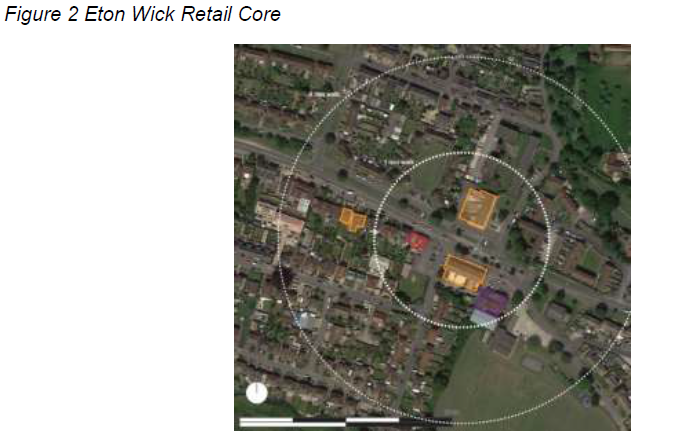
The policy shall conserve the retail core area with both sides of the main road remaining in commercial uses. Whereas the few units outside the retail core can revert to residential use, should they be unviable in a commercial use.
This policy is consistent with the consultative input that desires enhancement to the centre of Eton Wick.
The Neighbourhood Plan supports initiatives to support the growth of new business and fill temporary vacant retail property. It has been determined through discussion that meanwhile uses13 could be a suitable solution to maintain healthy high streets in Eton and Eton Wick.
To maintain a healthy retail environment, applications for a temporary change of use for pop-up shops shall be supported for a period of up to 12 months, provided the retail premise has been vacant and marketed for a period of three months and the pop-up services reflect the character of the area in general conformity with policies BL1 and BL2.
In the wake of emerging technologies and online consumer spending, high street retailers have to adapt to a more dynamic retail approach. Many high streets have witnessed retail closures in recent years, and this policy is intended to offer opportunities for the High Street to support new businesses, most in response to the community-identified issues of vacant retail units in Eton Wick, support for new shops in Eton, and preferences for independent businesses. This approach is supported by the Department for Communities and Local Government; Government has prepared guidance and template leases for landlords and prospective tenants14.
Eton Wick has a population of 2,500 people, yet to use local GP services residents are required to travel around a mile to reach these services. The population in Eton Wick is ageing and the need for a nearby medical centre is increasingly important. The following policy has been drafted to promote the creation of a new medical centre in Eton Wick to support local residents.
The provision of a small-scale satellite healthcare facility in the Neighbourhood Area will be supported, subject to there being no over-riding harm to local character, residential amenity and/or highway safety.
There is strong support from consultation for a satellite health facility in Eton Wick. Across the local population, almost 50% of residents are aged 45 and over. Furthermore, there has been a 20% increase in residents aged 85 and over. Eton Wick, more so than Eton, has an ageing population who will benefit from interventions that reduce the distance they need to travel for care. In the past Eton Wick has benefited from healthcare professionals providing targeted services, e.g., once a month baby weighing service. Current bus timetabling allows for limited periods of time to travel between Eton Wick and Eton. Consequently, the Eton Wick community struggles to receive a reasonable service from their current surgery solution located in Eton.
This policy aims to support changes of use for buildings that could serve as satellite facilities to the main surgery in Eton. This approach would be within a walkable distance for the majority of residents. New healthcare provision in Eton Wick must not be to the detriment of the existing medical services in Eton.
11 See Appendix 7 Eton and Eton Wick Local Centre Maps
12 The area shown within the inner white dotted line represents a 1 minute walking distance. Retail, business and leisure uses are encouraged here.
13 'Meanwhile use' is the temporary use of vacant buildings or land for a socially or commercially beneficial purpose until such a time that they can be brought back into long term commercial use again.
14 Accessed at:https://www.gov.uk/government/collections/meanwhile-use-leases-and-guidance-forlandlords
< Previous | ^ Top | Next >