
4.1 The NPPF states that where major development involving the provision of housing is proposed, planning policies and decisions should expect at least 10% of the total number of homes to be available for affordable home ownership11. In the Royal Borough of Windsor and Maidenhead where meeting housing needs, particularly for affordable housing, is a strategic priority, Policy HO3 of the Borough Local Plan seeks a minimum of 30% affordable housing units on sites proposing more than 10 net additional dwellings. Key drivers for these policies are the demographic trends in the borough, the evidence of need for affordable housing set out in the strategic housing market assessment, and the needs of individual communities for additional housing of a range of costs and tenures as part of their development as communities and more sustainable places. For Datchet these needs apply but must be balanced against the significant constraints that are imposed by the Green Belt designation and the flood zones. It is therefore considered that housing development within the Neighbourhood Plan area will be relatively limited. The main location for new housing is expected to be on the land at Riding Court Road and London Road allocated in the Borough Local Plan (Policy ref AL39) which has a site-specific requirement that development should provide at least 40% affordable housing. Rather than seeking new sites for development, the focus of the Neighbourhood Plan is on ensuring that the right type of housing development is brought forward.
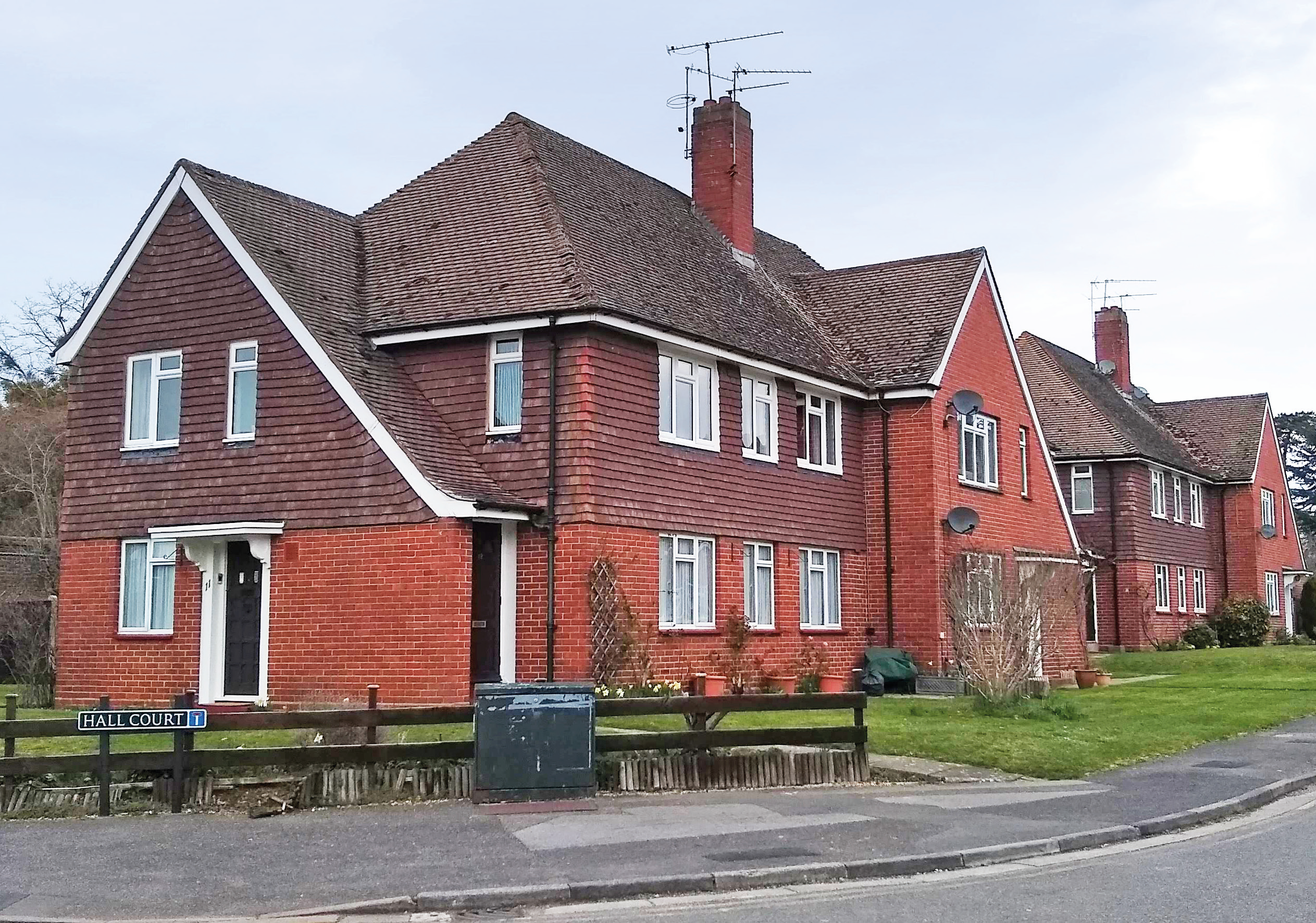
4.2 An issue raised by a large number of people in the community related to housing for older people. There is a concern that there is a lack of properties suitable for people’s needs as they age. This can take many forms from simple ‘downsizer’ housing which is more suitable in size and provision for people who previously raised families in a larger family home, to housing which is specifically designed to allow for people’s needs where their mobility is restricted, e.g. doorways wide enough for wheelchairs, stair lifts or simply single-storey housing.
4.3 Borough Local Plan Policy HO2 already requires developments of 20 or more dwellings to provide at least 5% of these as ‘accessible and adaptable dwellings’ (in accordance with Building Regulations M4(2)). It also supports the provision of purpose-built and-or specialist accommodation with care for older people, although no sites for such provision have been identified in Datchet.
4.4 The 2016 Berkshire Strategic Housing Market Assessment (SHMA)12 identified a need for a focus on 2 and 3-bedroom properties in the market housing sector, with an emphasis on 1-bedroom units in the affordable sector. This supports the position in Datchet where 14% of the population was of retirement age (65+) in 2011, and a further 12% would have reached retirement age by 2020. Similarly, analysis of households in 2011 shows that one-third consisted of either one person of retirement age or a married couple with no dependent children.
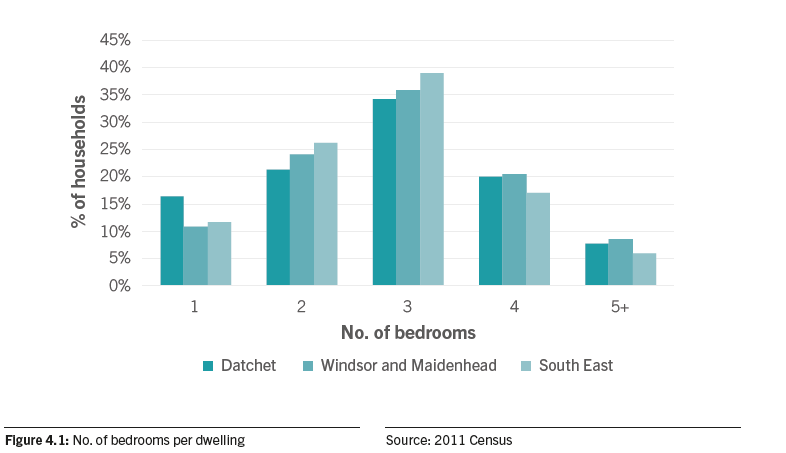
4.5 By contrast, the proportion of dwellings that are of a size which tends to be sought by downsizers (2- and 3-bed properties) is low, whereas the proportion of 4-beds is relatively high (Figure 4.1).
4.6 If more downsizing units are provided, then that may mean that older people living in family-sized houses may move, so freeing up these units.
4.7 A research project at the University of Sheffield called ‘Dwell — designing for wellbeing in environments for later life’ had a report published in 201613 which identified the ideal downsizer home as:
“A home that continues to allow people to pursue the pleasures of life today, while feeling secure that their homes can adapt to their future needs.”
4.8 While the report acknowledged that there is no one ‘ideal’ downsizer home, a number of common themes emerged through the co-design process undertaken with older people:
4.9 The Neighbourhood Plan community survey and focus group results generally concurred with the findings of the Dwell research project. The following themes also emerged:
4.10 Policy DAT1 applies to all major residential development — ‘major’ is defined in the NPPF as sites of 10 or more homes or sites of 0.5 hectares or more.
New homes designed to meet the needs of older people may include the following:
POLICY DAT1: HOUSING SUITABLE FOR THE NEEDS OF OLDER PEOPLE
Major residential development must provide a mix of dwelling types to include units designed to meet the needs of older people.
11 NPPF paragraph 65
12 GL Hearn (2016) Berkshire (including South Bucks) Strategic Housing Market Assessment, for the Berkshire authorities and Thames Valley Berkshire Local Enterprise Partnership
13 University of Sheffield (2016) Designing with downsizers, UK Research Councils (EPSRC, ESRC, and AHRC)
< Previous | ^ Top | Next >