
This Neighbourhood Plan was prepared by a group of around 50 local residents from Ascot, Sunninghill, Sunningdale and the surrounding area, formed into a Neighbourhood Plan Steering Group and Topic Groups, and working in partnership with the two Parish Councils.
The NP Steering Group was formed in early 2011 with the support of the Borough and under the auspices of the Sunninghill & Ascot and Sunningdale Parish Councils. Its mandate was to drive the process, consult with the local community and deliver the Plan. With the support of RBWM, our area Neighbourhood Plan was given Front Runner (pilot project) status and funding by the government.
A launch event was held in September 2011 at Ascot Racecourse to engage the wider community, with over 150 people contributing their views on what they liked about our area, the key issues facing us and how they would like to see its future develop. A number of new volunteers were also recruited, to form the nucleus of four Topic Groups – Housing & Environment, Economy, The Community and Transport & Infrastructure – whose role became to collect evidence and help with public consultations.
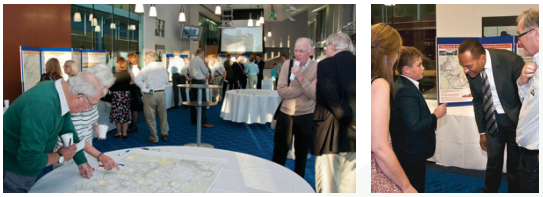
With help from Design Council CABE, a draft vision and suggested priorities for our neighbourhood were drawn up, based on the launch event feedback and Topic Group work. These were put out to public consultation in April 2012, with detailed Questionnaires delivered to essentially all households and businesses in the area. We had 550 respondents, representing a very high 7% response rate (over double that typically achieved in the past on planning consultations). Over half of all respondents also added free text comments to their questionnaires.
In summer 2012 we ran a survey among the community to solicit views on how we should try and improve Ascot High Street. Further specific consultation took place in October 2012 on the potential for redeveloping the centre of Ascot, with The Prince’s Foundation facilitating a 3-day workshop and a series of community events, building on previous consultations to develop specific plan strategies and ideas. These events were attended by 200–250 people from the local community.
In December 2012 we conducted an “Options” consultation to consult local residents on key aspects of the Plan including the village centres, strategic sites and major policies. A total of 510 respondents participated, again a very high number, especially bearing in mind the detail and complexity of the questions.
A proposed Neighbourhood Plan was developed from these consultations, from all the other consultations and interviews conducted by members of the Neighbourhood Plan team and from research and evidence collected by them.
Throughout the Plan’s development we have also liaised very closely with RBWM to ensure not only that our policies are in general conformity with the existing Local Plan but are also unlikely to conflict with policies being progressed in the emerging Borough Local Plan.
Sunninghill & Ascot Parish Council as the agreed Qualifying Body, with the support of Sunningdale Parish Council put our proposed Plan forward to the public and to statutory bodies for a six-week consultation period. Based on feedback from this consultation, some further amendments were made to the Plan, resulting in a draft Neighbourhood Plan.
The Qualifying Body submitted the draft Plan to RBWM, who publicised it for six weeks and then forwarded it with accompanying documents and all representations made during the publicity period to an independent Examiner, to review it and to check that it met the appropriate conditions. The Examiner submitted his report to the Borough, confirming that, subject to certain recommended modifications, the Plan did meet the required conditions, and he recommended that it be put forward to be voted on in a public referendum. This is expected to take place towards the end of March 2014.
The referendum question will be a straight “yes” or “no” on the entire Plan, as set out by Neighbourhood Planning regulations. People won’t be able to vote for or against individual policies. If 50% or more of those voting vote for the Plan, it will be brought into force and become part of planning policy. If fewer than 50% vote for it, there will be no Neighbourhood Plan for our area.
It is important to note that not having a Neighbourhood Plan does not mean that development won’t happen. Development will take place, but without the policies in this Plan, which set out the type of development that is in keeping with our area’s character and where it should go, having any effect. Decisions will instead be based on the Borough’s policies and national guidance.
< Previous | ^ Top | Next >