
Colchester is a diverse and growing Borough, with a vibrant town centre, attractive villages and important natural landscapes. Over the next 15 years the Borough will face many challenges, such as housing growth, evolving economic trends and the need for more sustainable transportation. To address these challenges, Colchester Borough Council is preparing a Local Development Framework (LDF) to meet the needs of current and future generations whilst also protecting and enhancing the environment and people’s quality of life.
The Local Development Framework (LDF) will plan, monitor and manage future growth and change in Colchester Borough up to 2021. While the previous Local Plan system focused on development control, the LDF will cover a broader range of spatial issues that contribute towards sustainable communities, including issues such as transport, employment and recycling.
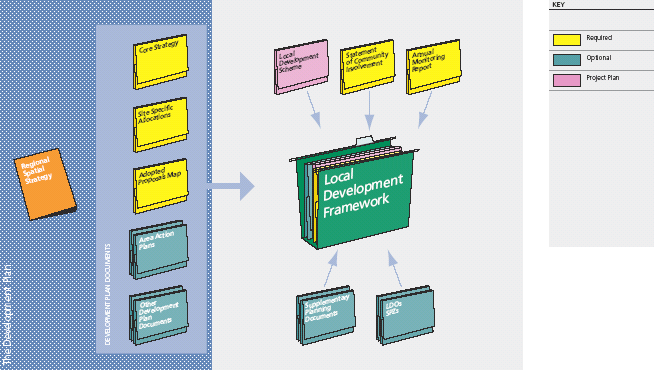
The Colchester LDF will comprise a range of Local Development Documents
(see Figure 1), including the following:
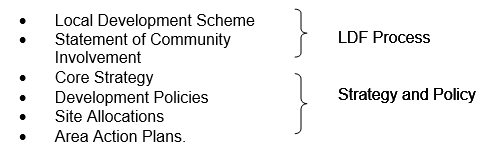
The Core Strategy is the central document of the Local Development Framework, and provides the broad policy directions to guide the other documents in the LDF. The Core Strategy will establish a long-term strategy to manage development, provide services, deliver infrastructure and create sustainable communities. It comprises the spatial vision and objectives, a spatial strategy, core policies and a section setting out how we will implement and monitor the strategy. Its effectiveness will be monitored on an annual basis through the Annual Monitoring Report and it will be reviewed when necessary.
The Council has undertaken a Sustainability Appraisal and an Appropriate Assessment of the Core Strategy to evaluate the sustainability of the proposed strategy, policies and options.
Figure 1. Local Development Framework
The new planning system requires the Core Strategy and the LDF to be consistent with national planning policy, the draft East of England Plan and the Community Strategy. All subsequent Development Plan Documents and Supplementary Planning Documents in the LDF will also need to be in conformity with the Core Strategy. Accordingly, the Core Strategy has been prepared in conformity with the following policies and strategies.
National Planning Policy
National planning policy is primarily set forth in Planning Policy Guidance
(PPG) which is progressively being updated and issued as Planning Policy
Statements (PPS). PPS 1 summarises six key principles of sustainable
planning which this Core Strategy seeks to follow:
Regional Planning
The East of England Plan (EEP) (published May 2008) is the Regional
Spatial Strategy for Colchester Borough and the LDF needs to be in general
conformity with it. The EEP outlines a range of policies and targets
relevant to spatial planning in Colchester. The most notable of these
include:
The Core Strategy is consistent with the East of England Plan and seeks to implement the policies and targets as they relate to Colchester Borough. Colchester also has many unique spatial issues that are not identified in the draft East of England Plan that will be addressed by the Core Strategy.
Colchester Borough forms part of the Haven Gateway sub region, which has been recognised as a ‘New Growth Point’. This special status will help deliver critical funding for vital infrastructure and development projects through a long-term partnership between Colchester Borough, the Haven Gateway Partnership and Communities and Local Government (CLG).
The Core Strategy is also consistent and supportive of the Regional Cities East (RCE) partnership. The RCE objectives for housing, prosperity, jobs and the environment can all be advanced through the Core Strategy and the LDF.
Community Strategy
The LDF provides the primary means of delivering the spatial elements
of Colchester’s Sustainable Community Strategy. The Community
Strategy was prepared by the public, private and community partners
forming the Colchester Local Strategic Partnership to set a long-term
vision for the community of Colchester. The Community Strategy and the
Local Development Framework share a commitment to the development of
objectives through community consultation and stakeholder involvement.
Accordingly, the Core Strategy builds on the Strategy’s Vision for Colchester in 2020:
Colchester, excelling as a prestigious regional centre that is:
Reaching across all these goals is a commitment in the Sustainable Community Strategy to carbon reduction. For the Borough Council, this means ensuring that all its strategies, plans and budgets, including the Local Development Framework, are designed with the goal of reducing the Borough’s carbon footprint.
More specifically, the Core Strategy will assist in the delivery of the Sustainable Community Strategy priorities (Table 1) which support the above vision.
Table 1 – Delivery of the Community Strategy
| Community Strategy Priorities | Core Strategy Policy |
|---|---|
| Transport | Accessibility and Changing Travel Behaviour (TA1) Walking and Cycling (TA2) Public Transport (TA3) Roads and Traffic (TA4) Parking (TA5) |
| Heritage & Culture | Regeneration (UR1) Built Design and Character (UR2) Community Facilities (SD3) Environment (ENV1) |
| London 2012 | Community Facilities (SD3) Open Space (PR1) |
| Business & Employment | Centres and Employment Classification and Hierarchy(CE1) Mixed Use Centres (CE2) Employment Zones (CE3) |
| Life Opportunities | Community Facilities (SD3) Housing Diversity (H3) Affordable Housing (H4) |
< Previous | ^ Top | Next >