
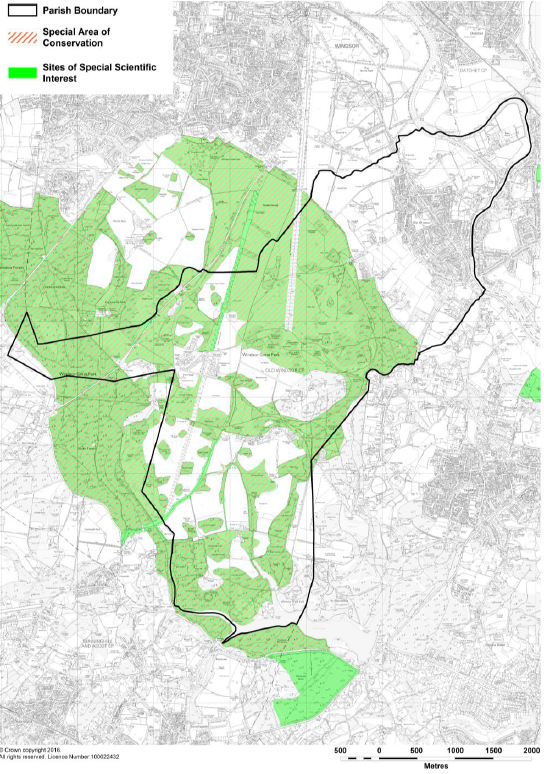
9.1 Old Windsor parish sits within a highly sensitive environmental area. It contains Windsor Great Park which is a designated Special Area of Conservation (SAC), Site of Special Scientific Interest (SSSI)10 and includes areas of ancient woodland, and Wraysbury Gravel Pits SSSI and Langham Pond SSSI. Because of the proximity of several wildlife corridors, species migration and therefore unidentified species locations are highly probable
Figure 9.1: Location of the Special Areas of Conservation and Sites of Special Scientific Interest
Protection of natural habitats, landscape and ecology
9.2 Engagement events held with the community to inform the Neighbourhood Plan highlighted that a particular concern of many is the perception of wildlife habitats being lost or put at risk from inappropriate development. Also residents expressed a wish to enhance and preserve the different species of wildlife seen in the village, giving examples of many that had been sited over time.
9.3 On this basis, the OWNP reviewed publicly available information to see if any biodiversity work had been undertaken. This made it evident that, despite a wealth of recorded sitings of many different species including some protected under European and national legislation, there was no body coordinating this information. As a result, OWPC commissioned an ecological consultancy to bring all the information together and provide interpretation of it through a Phase I Habitat Survey and ecological study11.
9.4 The study showed that a number of species such as bats, otters, water voles protected by the Wildlife and Countryside Act 1981 (as amended) and the Conservation of Habitats and Species Regulations 2017; were identified during the Phase 1 Habitat Survey. This was along with the following Species of Principle Importance under the Natural Environment and Rural Communities (NERC) Act 2006:
9.5 In addition, the following species of principal importance under the NERC Act are on the Thames Valley Environmental Records Centre (TVERC) sitings register:
9.6 The Phase 1 Study shows that many of these species are supported by the habitats within the Old Windsor Neighbourhood Plan area.
9.7 Despite this protection in law, it is vital that the requirements of the NPPF are met in respect of biodiversity, in terms of practically minimising impacts and providing net gains where possible. In order to achieve this, it is considered necessary to provide planning policy guidance in addition to that in the NPPF and the Windsor and Maidenhead Local Plan. This is due to the unique positioning of Old Windsor in respect of these SACs, SSSIs and LWSs. The Phase I Habitat Survey demonstrates that there are a significant number of local species that require adequate protection in order to comply with the NERC Act and the NPPF. OWPC considers its statutory duties under section 40 of the NERC Act to be a high priority that the national and local planning policy framework does not necessarily adequately support, so requiring locally-specific policy support in the Neighbourhood Plan.
9.8 It is imperative that any potential harm arising from proposed development, is where possible avoided, mitigated or compensated in accordance with relevant good practice such as Biodiversity Net Gain: Good practice principles for development 12.
9.9 Well-designed developments should be able to properly establish the location of habitats and the movement patterns of animals and wildlife such that development does not impact on these. The relocation of any habitat should only be undertaken as a last resort when it is proven that a scheme cannot be designed to accommodate them in their existing location (including consideration of whether a reduced quantum of development would provide a solution). In order to reduce the impact of any such relocation, this should be as close as possible to the current location and alternative locations should be identified in partnership with any appropriate wildlife body operating in the area. These measures will help to deliver the strategy of the Berkshire Local Nature Partnership13 and national strategies such as the National Pollinator Strategy referred to in the strategy.
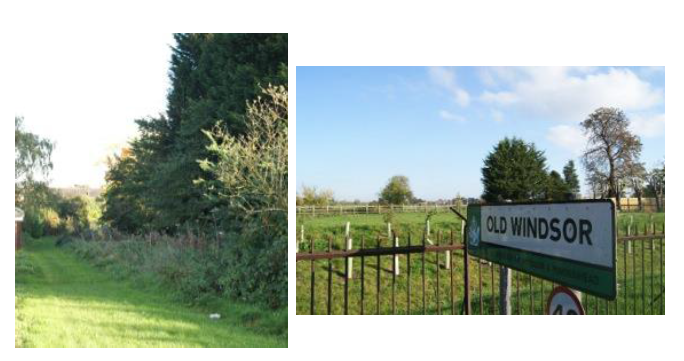
9.10 Old Windsor has two areas adjacent to the existing settlement area that have historic landscape integrity. They are:
9.11 Across the Neighbourhood Plan area there are other examples of small-scale features that are particularly distinct within this landscape. These include mature trees, hedgerows, woodlands, field margins and ponds. Such features should be retained as part of any development.
POLICY OW14: PROTECTION OF NATURAL HABITATS, LANDSCAPE AND ECOLOGY
Development will not be supported which is likely to:
Where following development a significant loss of trees and/or shrubs occurs, proposals which include appropriate mitigation through re-provision in situ, or elsewhere on the site as appropriate, will be supported, including planting of native tree species with local provenance where such loss is of mature trees.
10 The Great Park is also a Local Wildlife Site, SSI and contains ancient woodland
11 Acorn Ecology Ltd (2015) Biodiversity Resource Report, for Old Windsor Parish Council
12 Biodiversity Net Gain: Good practice principles for development. CIEEM, CIRIA, IEMA, 2016
13 Berkshire Local Nature Partnership (2014) The Natural Environment in Berkshire: Biodiversity Strategy 2014-2020
< Previous | ^ Top | Next >