
1. Penny Royal Almshouses – Crimp Hill
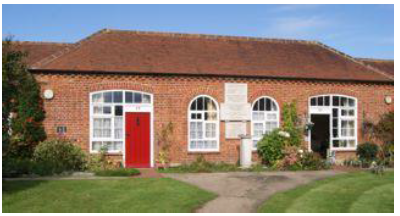
In 1594 Alexander Morley left £20 per year for ever to ‘the poore and needy people of Old Windsor’. This money invested in land and other securities and was spent in 1797 on the building of the original almshouses. Throughout their life the almshouses have been regularly maintained to standards suitable at the time. In 1976, six additional almshouses were built and in 1990 the original six were practically rebuilt, retaining the original facades but updating the interior.
2. Fox & Punchbowl - Burfield Road
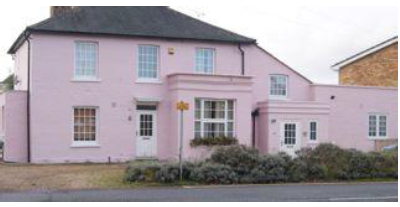
The first mention of The Fox and Punchbowl is in 1846 when the landlord and the pub also served as the Village Post Office with part of the premises serving as a shop. It appears to have continued as a Public House until the 1960’s when it was divided into two private dwellings.
3. Newtonside – Burfield Road
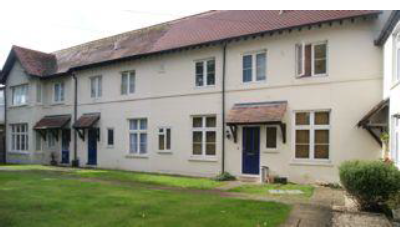
The ‘Ramping Cat Cottages’ are all that remain of the Ramping Cat Public House that ceased trading around the 1820’s. In 1882 the cottages came into the possession of Sir Charles and Lady Murray owners of Newton Court, opposite. In 1882 Lady Murray established the Murray Convalescent Home, taking patients from London Hospitals. At first children, then the elderly and then during the 1st world war it was used for convalescent soldiers. It survived until 1828 and is now private dwellings.
4. Manor Lodge Cottage – Royal Windsor Stained Glass Manufactory – Straight Road
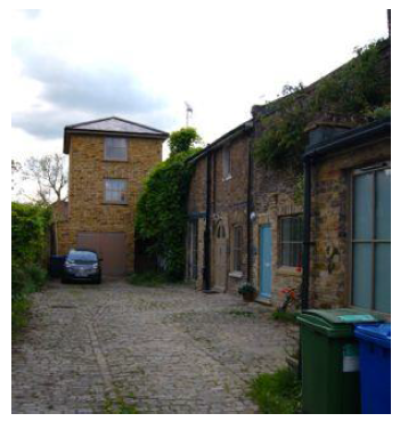
Established shortly after the Tapestry Works in 1878 by Prince Leopold the glass works produced a number of significant pieces of work. Among them a large rose window in the Beaumont Chapel, windows for the Royal Chapel in Windsor, St Edwards Roman Catholic Church, Windsor and in St. Agnes Church in Spital. When the Tapestry Works closed in 1890 the Stained Glass works was sold and moved to Windsor. The building remained and is now a private dwelling.
5. The Tapestries – The Old Windsor Tapestry Manufactory – Straight Road
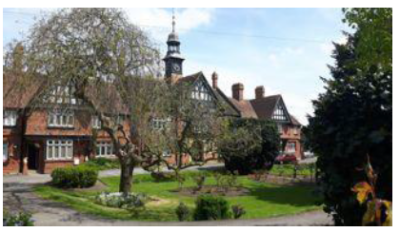
The Tapestry was established in 1876 as a local response to the ‘Art & Craft’ movement popular at the time. Prince Leopold was President of the Committee of Guarantors and weaver were brought to Old Windsor from Aubusson in France.
The central part of the building was the Hall where the weaving took place and the remainder of the building provided homes for the weavers. The works closed in 1890 and the building was used as residential accommodation. The Hall continued to be used as the Village Hall until 1961. In 1970 The Hall was converted into additional flats. The buildings are presently owned by The National Benevolent Charity.
6. The Bells of Ouseley – Straight Road
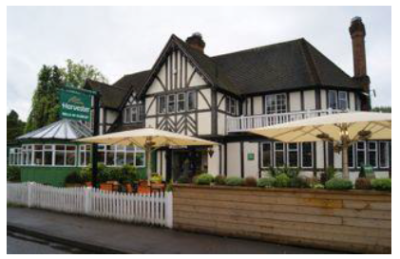
There has been an Inn on this site for many years. The Bells has featured regularly in both literature and art with references in ‘A Voyage up the Thames’ published in 1738 and Jerome K Jerome’s ‘Three Men in a Boat’ published in 1889 to name but a couple. The Bells is currently owned by Mitchell & Butlers and is part of their Harvester chain.
7. The Jolly Gardeners – St Lukes Road
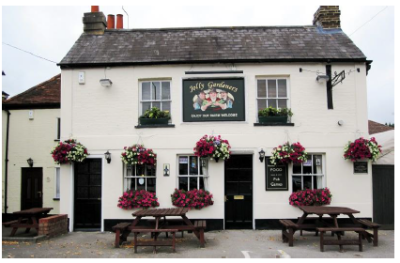
In 1830 an Act of Parliament was passed to attempt to control the availability of spirits by permitting the establishment of Beer Houses, they were not allowed to sell spirits. The ‘Gardeners’ was one of the 3 public houses in the village that was originally a beer house and first traded in 1854 as a ‘beer retailer and grocer’.
8. The Oxford Blue – Crimp Hill
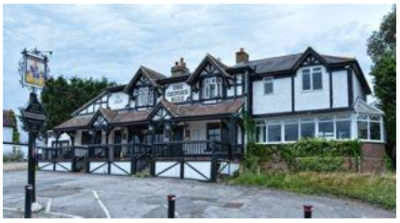
Thomas Evans joined the Royal Regiment of Horse Guards in 1800, aged 19. He served under Wellington in 1813 and later in 1815 at Waterloo. In 1829 he retired from the army and started the ‘Oxford Blue’. The name is derived from the name of his troop, and the gamekeepers’ cottages, acquired from the nearby Woodside estate, were converted into an Inn. The licence was transferred from an older pub in the village called The Ramping Cat.
(Source for text: Margaret Gilson – ‘Buildings of Old Windsor’)
< Previous | ^ Top | Next >