
1. Unless stated otherwise, the profile of the community has come from the 2011 Census.
Population
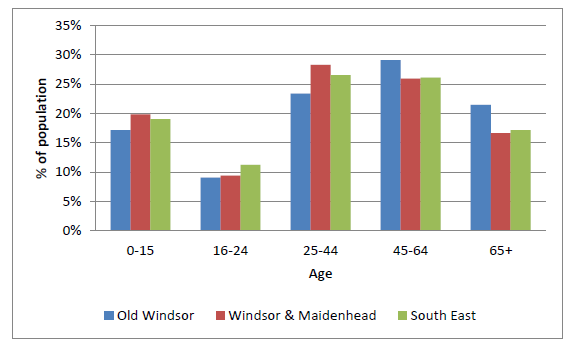
2. In 2011, the population of the parish was 4,977. Compared to Windsor and Maidenhead Borough, it has a low proportion of both children of under 15 years of age and younger adults between 25 and 44 years of age. This suggests a comparatively low proportion of young families. By contrast, it has a high proportion of adults aged 45 to 64, suggesting that a good number of people will be approaching retirement age over the plan period. This is supported by the high proportion of people that have already reached retirement age.
Figure A1: Population profile, 2011
Source: 2011 Census
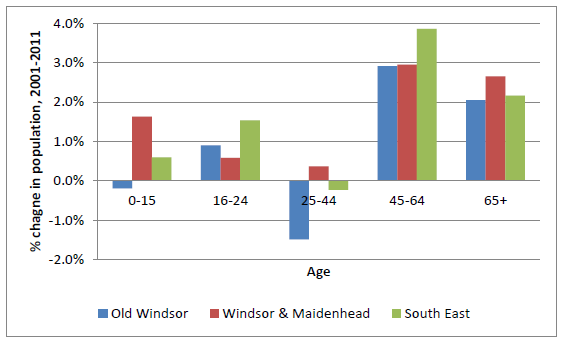
3. Since 2001, the population has grown by 200 people, a 4.2% change compared to 8.2% growth in the Borough as a whole. This is reflective of the restrictions on growth in Old Windsor due to the presence of the green belt. What is particularly interesting is the change in population by age group.
4. Figure A2 shows that almost all of the growth in population came from those aged 45 and over. By contrast, the number of people that typically make up young families (both children up to the age of 15 and adults of between 25 and 44) fell considerably. So not only is this profile of a comparatively low proportion of young families evident in Old Windsor, the position is worsening.
Figure 2.2: Change in population, 2001-2011
Source: 2011 and 2001 Census
Work
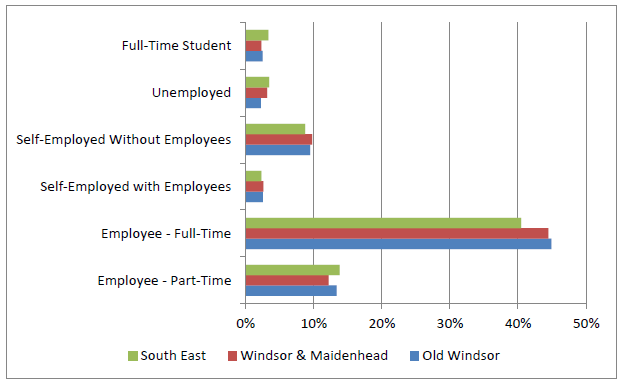
5. Three-quarters of the population of working age in Old Windsor parish is economically active, which is slightly higher than the Borough and regional average. Unemployment is low and the proportion in full-time employment is high. The picture overall is very similar to the profile of Windsor and Maidenhead Borough.Figure A3: Economic activity, 2011
Source: 2011 Census
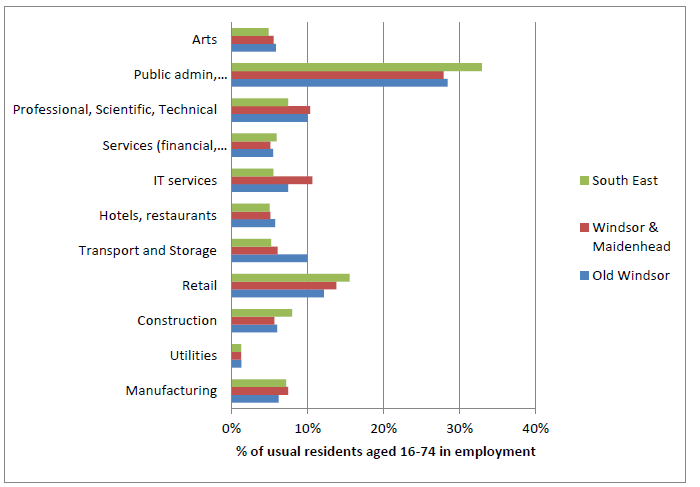
6. The sectoral profile of the workforce of Old Windsor does show some particular features. The proportion employed in public administration, education and health – traditionally a well represented sector – is low. Equally, the number employed in transport and storage is comparatively high due to the proximity of Heathrow Airport.
Figure A4: Type of industry, 2011
Source: 2011 Census
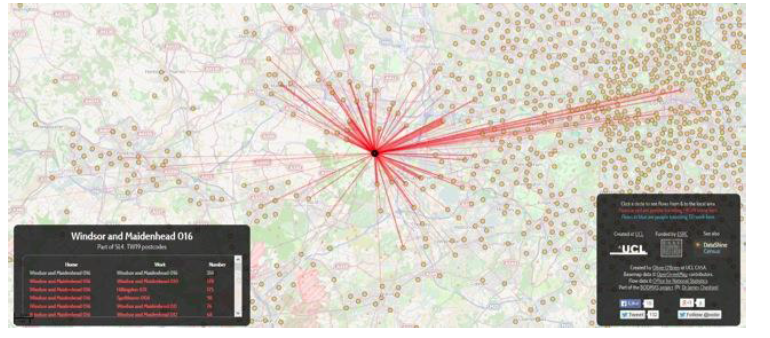
7. When looking at where people work, it is clear that the significant majority of workers leave the parish to access work. Figure A5 shows that a significant flow is in to Central London which is not surprising. Other flows are more local to centres of employment such as Heathrow, Staines and Slough.
Figure A5: Flow of workers from Old Windsor
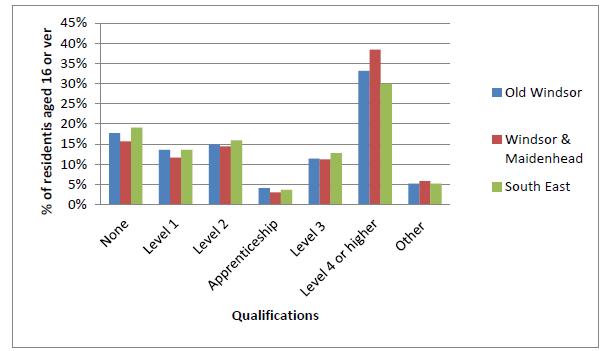
8. Figure A6 shows that there are significant numbers of people with lower levels of qualification, i.e. up to Level 2. The nature of local job opportunities means that many of these people will be accessing jobs in the transport and storage sector at, in particular, Heathrow Airport. By contrast, the proportion of people that are educated to Level 4 or higher is lower than the Borough average.
Figure A6: Qualifications of residents aged 16 and over
Source: 2011 Census
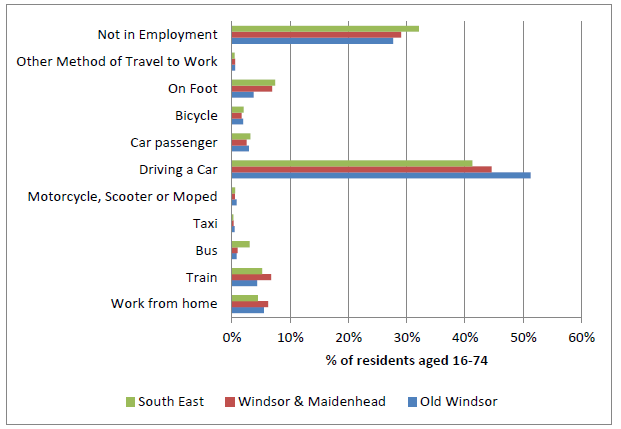
9. The large majority of those in work travel to work by car, and do so as the driver of that car. Moreover, this is well above the Borough average. The numbers of people that use the train and buses is very low which highlights that public transport links from Old Windsor are not as good as many other parts of the Borough and explains in turn the high car usage.
10. This is further supported by Census figures on access to a car within households. On average, each Old Windsor household has access to 1.63 cars. This compares to 1.50 cars per household in Windsor and Maidenhead Borough and 1.35 cars per household across the South East. This represents high levels of car ownership.
Figure A7: Mode of transport to work
Source: 2011 Census
Housing
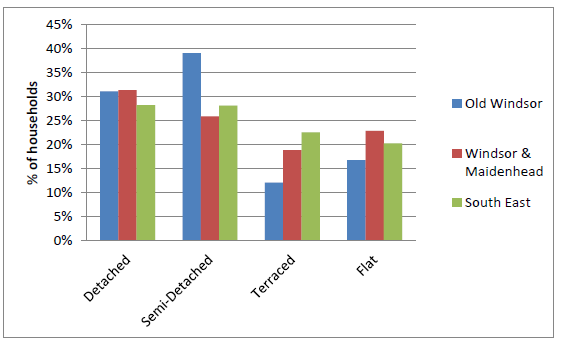
11. Old Windsor is dominated by semi-detached housing, representing nearly 40% of its housing stock. However, there is also a significant proportion (over 30%) of detached housing. By contrast, the proportion of terraced housing and flatted development is very low.
Figure A8: Type of dwelling
Source: 2011 Census
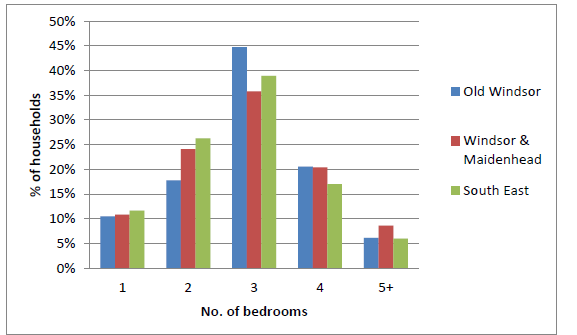
12. This is reinforced when looking at the number of bedrooms that properties in Old Windsor have. Figure A9 shows that it has a very high proportion of 3-bed properties when compared to the Borough or the South East as a whole. By contrast, the proportion of 1- and particularly 2-bed properties is much lower.
Figure A9: Number of bedrooms
Source: 2011 Census
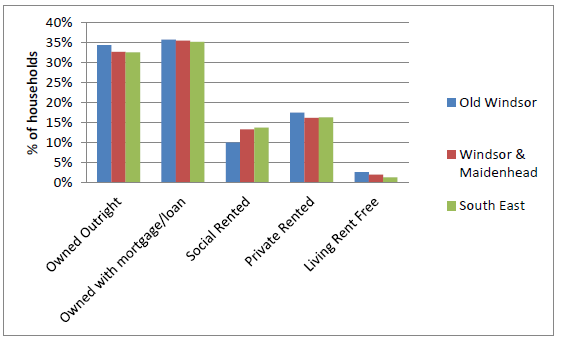
13. The ownership profile of these dwellings shows that approximately 70% of people own their property which is broadly in line with the Borough average. By contrast, the proportion that are social rented properties is low, at just 10%. This potentially creates issues for people unable to access housing on the open market, either to buy or to rent.
Figure A10: Ownership profile
Source: 2011 Census
14. The Windsor and Maidenhead Strategic Housing Market Assessment (SHMA)14 was published in 2014. This highlighted that affordability is a significant issue. The Borough has significantly higher affordability ratios than the rest of the wider housing market area and the region, i.e. it is harder for the lowest earning local residents to afford to buy a property. The average house price in the Borough was £440,000, compared to an average of £330,000 across the housing market area. The SHMA summarises that it is more difficult to get on the property ladder in Windsor and Maidenhead Borough than it is to move up it.
15. The SHMA proposes that, based on the evidence, 57% of new dwellings by 2029 should be one-bedroom, with a further 22% as two-bedroom dwellings15. This reflects a significant change in provision compared to the existing stock of properties.
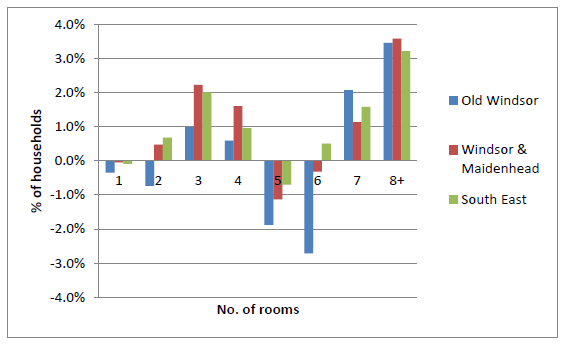
16. This situation for the whole of the Borough certainly applies to Old Windsor. Figure 2.8 showed that Old Windsor has a low proportion of smaller properties. Figure A11 shows that, since 2001, the predominant type of dwelling that has been built is of the largest size – with 7 or more rooms.
Figure A11: Change in dwelling stock by number of rooms, 2001-2011
Source: 2001 and 2011 Census
17. By contrast, there have been large falls in the number of the very smallest dwellings (1 and 2 rooms) and also of medium-sized properties (5 and 6 rooms). The latter trend, coupled with the relatively limited growth in the overall number of dwellings, suggests that much of the growth in these larger properties is coming from extensions of smaller properties.
18. There is a clear need for new properties that are built in Old Windsor to be smaller dwellings.
14 GVA (2014) Royal Borough of Windsor and Maidenhead Strategic Housing Market Assessment, for Royal Borough of Windsor and Maidenhead
15 Source: SHMA, Figure 113
< Previous | ^ Top | Next >